
WILD 70 — PRE-RACE ANALYSIS
WILD 70 — PRE-RACE ANALYSIS
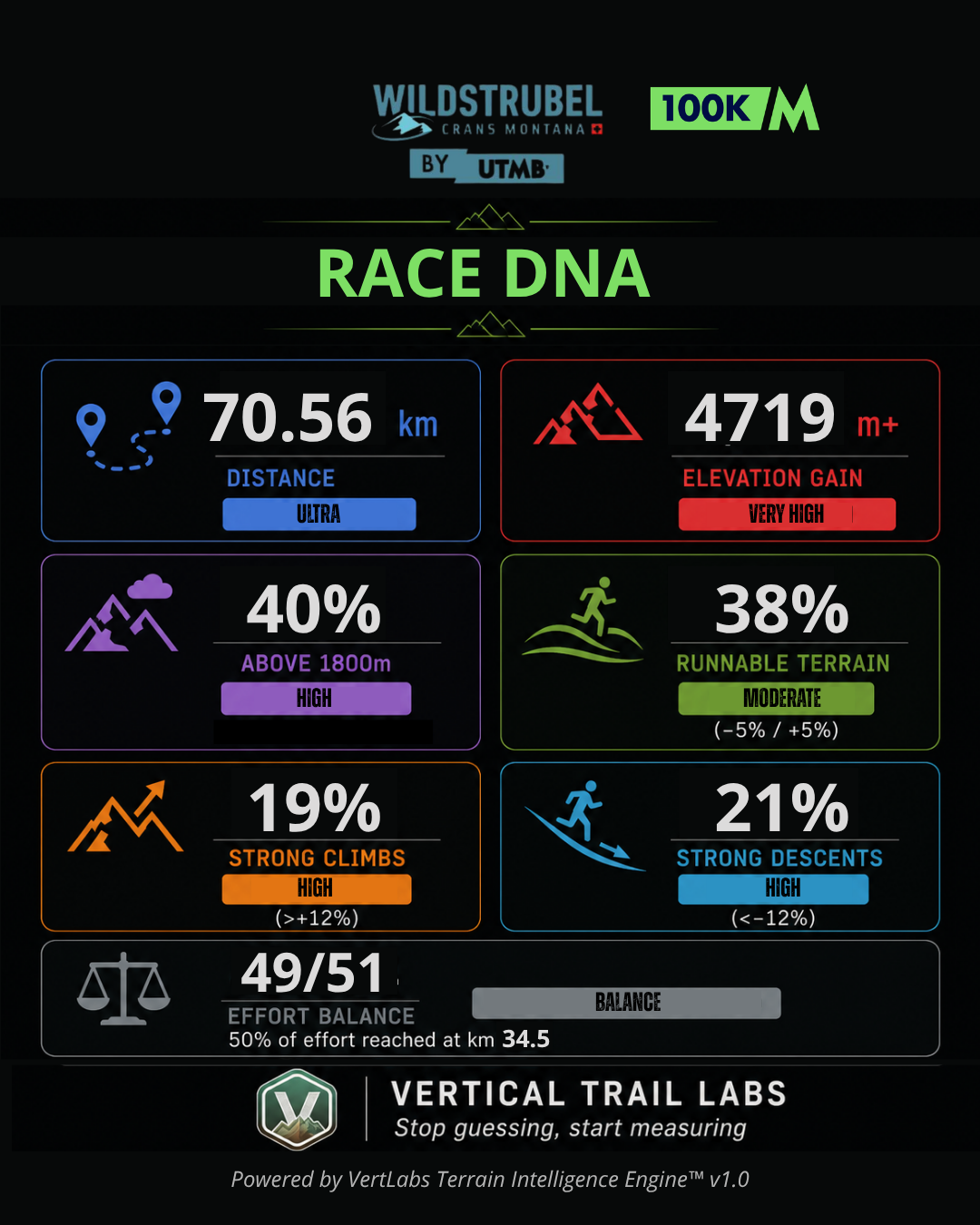
Wild 70 may sit below the 100 km barrier, but its vertical density tells a different story. With 4,719 m of climbing packed into just 70.56 km, the VertLabs Terrain Intelligence Engine™ classifies the course as Very High vertical load. This is a compact Alpine ultra where elevation, altitude and technical terrain accumulate quickly.
The official 2026 course is 72 km with 4,600 m+, starting in Kandersteg and finishing in Crans-Montana. The race starts tomorrow, September 11, at 07:00, with three waves through 07:20 and a 17h30 time limit.
A course built around repeated altitude changes
The opening is immediately demanding. From Kandersteg, runners climb toward Bunderschrinde, before heading toward Adelboden and the Chuenisbärgli ski area. The route then continues over Hahnenmoospass before descending toward Lenk. This creates a first major sequence of climb → descent → climb rather than a simple progressive ascent.
The decisive Alpine block comes later. From Lenk and Iffigenalp, the course rises toward the Wildstrubel Hut at 2,800 m, the highest point of the race. After Rawil Pass, the route returns toward the Valais through the Tseuzier reservoir and the Bisse du Ro before the final approach to Crans-Montana.
That profile is clearly reflected in the Race DNA. 40% of the analyzed course is above 1,800 m, while only 38% is classified as runnable rolling terrain. At the same time, 19% is Strong Climb (>12%) and 21% Strong Descent (<−12%).
That combination is important: this isn't simply a race with a lot of elevation. A large proportion of that elevation is concentrated in terrain where both climbing and descending efficiency become decisive.
The biomechanical challenge
The profile reveals threhe profile reveals three distinct demands.
First, climbing economy. The opening ascent already establishes the vertical cost, and the major climb toward 2,800 m comes after the course has already accumulated substantial climbing and descending.
Second, downhill durability. With 21% Strong Descent, the descents are not merely opportunities to recover. They are biomechanically expensive sections where braking forces can accumulate rapidly. Arriving at the Wildstrubel Hut climb with compromised legs could be more consequential than losing a few minutes on an earlier ascent.
Third, altitude management. With 40% above 1,800 m and the course reaching 2,800 m, altitude is a meaningful part of the race's identity. The highest section arrives relatively deep into the course, making efficiency before that point particularly important.e distinct demands.
Effort is almost perfectly balanced
The VertLabs effort model places the 50% effort point at km 34.5, producing a 49/51 effort balance.
That is one of the most interesting characteristics of this course.
There is no obvious point where the race can be divided into an "easy first half" and a "hard second half." The physical workload is almost perfectly distributed around the midpoint. The runner reaches half of the total effort at approximately half of the physical distance.
This means pacing errors early in the race can be particularly costly. There is enough climbing in the opening sections to create fatigue, but the most significant altitude and technical demands are still waiting later.
THE VERTLABS TAKE
Wild 70 is a compact Alpine ultra where vertical density replaces distance as the main source of difficulty.
At 66.9 m+/km, with 40% above 1,800 m, 19% Strong Climb, 21% Strong Descent and only 38% runnable terrain, the course demands a balanced athlete: strong enough to climb, efficient enough to descend, and disciplined enough not to spend too much of the available reserve early.
The key isn't simply reaching 2,800 m.
It's reaching the highest point with enough mechanical efficiency left to race the final 20+ kilometres toward Crans-Montana.
Wild 70 doesn't have one decisive section. It is a succession of decisions — climb efficiently, descend economically, and never spend more than the course gives back.