
Val d'Aran by UTMB - VDA 160K – Pre-Race Analysis
The Val d'Aran by UTMB 160K is a race that immediately stands out for its relentless vertical profile rather than its sheer distance alone. Covering 160.0 kilometers with an astonishing 11,441 meters of elevation gain, this course belongs to the highest tier of mountain ultras where climbing ability, durability, and pacing strategy become far more decisive than pure running speed. Using the VertLabs Terrain Intelligence Engine™, the official GPX has been decomposed into biomechanical terrain categories to better understand how the course distributes physical demands throughout the race.
A course built around Verticality
The first defining characteristic of Val d'Aran is its Vertical Density.
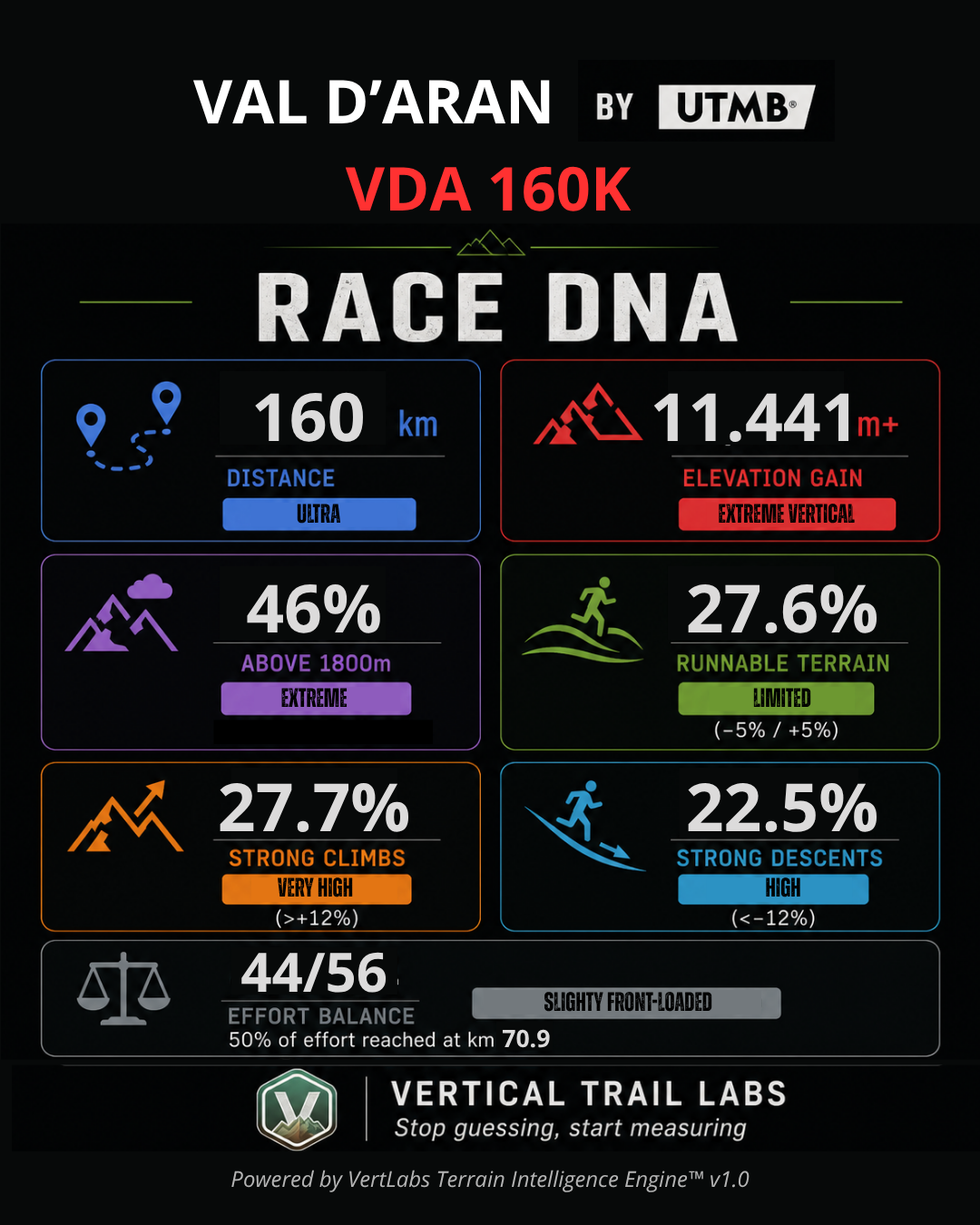
With 71.5 meters of ascent per kilometer (mts+ / km) , the race earns a Very High classification, placing it among the steepest ultra-distance mountain courses. This figure highlights an important distinction: the challenge is not only the total elevation gain but how frequently elevation changes occur.
Rather than featuring a handful of long climbs separated by runnable valleys, the terrain constantly alternates between climbing and descending, preventing runners from settling into a prolonged rhythm.
This continuous vertical load increases muscular fatigue throughout the event and places a premium on efficient hiking techniques during the steepest ascents.
Altitude is a constant companion
Perhaps the most remarkable feature revealed by the Race DNA analysis is the course's Altitude Exposure.
Nearly 74 kilometers of the route—approximately 46% of the entire race—take place above 1,800 meters, earning an Extreme classification.
Unlike races that briefly cross high mountain passes before descending into lower valleys, Val d'Aran keeps runners exposed to altitude for extended periods. Reduced oxygen availability, cooler temperatures, and cumulative fatigue all become significant performance factors during these prolonged high-altitude sections.
For athletes accustomed to training at sea level, this prolonged exposure can noticeably increase perceived effort even when maintaining conservative pacing.
Running opportunities are limited
One of the most informative metrics generated by our Engine is Terrain Flow.
Only 27.5% of the course falls within the rolling terrain category (-5% to +5% slope), resulting in a classification of Limited Running Opportunity.
This statistic fundamentally changes how the race should be approached.
Many ultras allow competitors to recover by running comfortably through long valley sections or gradual terrain. Val d'Aran offers comparatively few of these opportunities. Instead, runners continuously transition between steep climbs, technical descents, and moderate gradients that still demand active muscular work.
In practical terms, the course rewards athletes capable of maintaining efficiency while hiking, climbing, and descending rather than those relying solely on fast running speed.
Climbing defines the race
The Terrain Intelligence Engine identified 44.4 kilometers with gradients equal to or steeper than 12%, representing 27.7% of the total distance.
This results in a Very High Climbing Aggressiveness classification.
These sustained steep sections significantly increase energy expenditure while placing considerable stress on the posterior chain, particularly the calves, quadriceps, glutes, and hip extensors.
Athletes who can efficiently alternate between power hiking and running on these gradients are likely to conserve energy over the course of the event. Conversely, attempting to run every climb may lead to premature fatigue long before the race reaches its decisive stages.
Descents demand equal respect
Val d'Aran is not only about climbing.
The course also contains 36.0 kilometers of slopes steeper than −12%, corresponding to 22.5% of the total distance and earning a High Descending Severity classification.
Steep descents create substantial excentric loading on the quadriceps and stabilizing muscles. While climbs elevate cardiovascular demand, descents often become the primary source of muscular damage during long mountain ultras.
Maintaining controlled descending technique becomes essential not only for preserving speed but also for protecting the legs for the latter stages of the race.
A surprisingly balanced distribution of effort

A surprisingly balanced distribution of effort
Despite its intimidating profile, Val d'Aran exhibits a relatively balanced distribution of workload.
The Effort Balance metric reaches 44/56, indicating that the second half of the race carries slightly more biomechanical demand than the first while remaining close to an even distribution.
Rather than concentrating all major climbs early or saving every challenge for the finish, the course progressively accumulates fatigue before increasing demands during the later stages.
Athletes who start conservatively are therefore more likely to benefit from preserved muscular strength as the race enters its decisive final sectors.
The data suggests that Val d'Aran rewards patience over aggression.
What the Race DNA reveals
When all metrics are considered together, a clear identity emerges.
Val d'Aran is not simply a long ultra with substantial elevation gain. It is a race designed around continuous biomechanical stress.
The limited amount of runnable terrain prevents prolonged recovery periods. Extended altitude exposure compounds physiological fatigue. Frequent steep climbs steadily drain muscular reserves, while equally demanding descents require excellent eccentric strength and technical control.
Unlike flatter ultras where aerobic efficiency often dominates performance, Val d'Aran shifts the emphasis toward mountain-specific abilities:
Efficient power hiking. Sustainable climbing economy. Technical descending skills. Muscular durability. Conservative pacing. Effective energy management. These characteristics collectively define the race far more accurately than total distance or elevation gain alone.
Final Assessment
According to the VertLabs Terrain Intelligence Engine™, Val d'Aran by UTMB 160K should be regarded as a highly technical mountain ultra where terrain—not distance—is the primary performance determinant.
In short, Val d'Aran is a race where success is earned not by running faster, but by moving more efficiently across every type of mountain terrain. It is an event that rewards intelligent decision-making, durable climbing legs, and the ability to preserve strength until the final kilometers—qualities that define the world's most accomplished mountain ultrarunners.