
Val d'Aran by UTMB- CDH 110km - Race Analysis
Race Overview
The 2026 Val d'Aran by UTMB® CDH 110K delivered exactly the type of race anticipated in the Vertical Trail Labs pre-race analysis: a highly demanding mountain ultra where climbing efficiency, descending technique and fatigue management proved far more decisive than outright speed.
Although the course covers approximately 110 kilometers, its more than 6,900 meters of vertical gain, long sustained climbs and highly technical descents created continuous physiological stress from the opening kilometers. High temperatures throughout the afternoon further increased the challenge, forcing athletes to carefully balance hydration, pacing and muscular preservation over more than thirteen hours of racing.
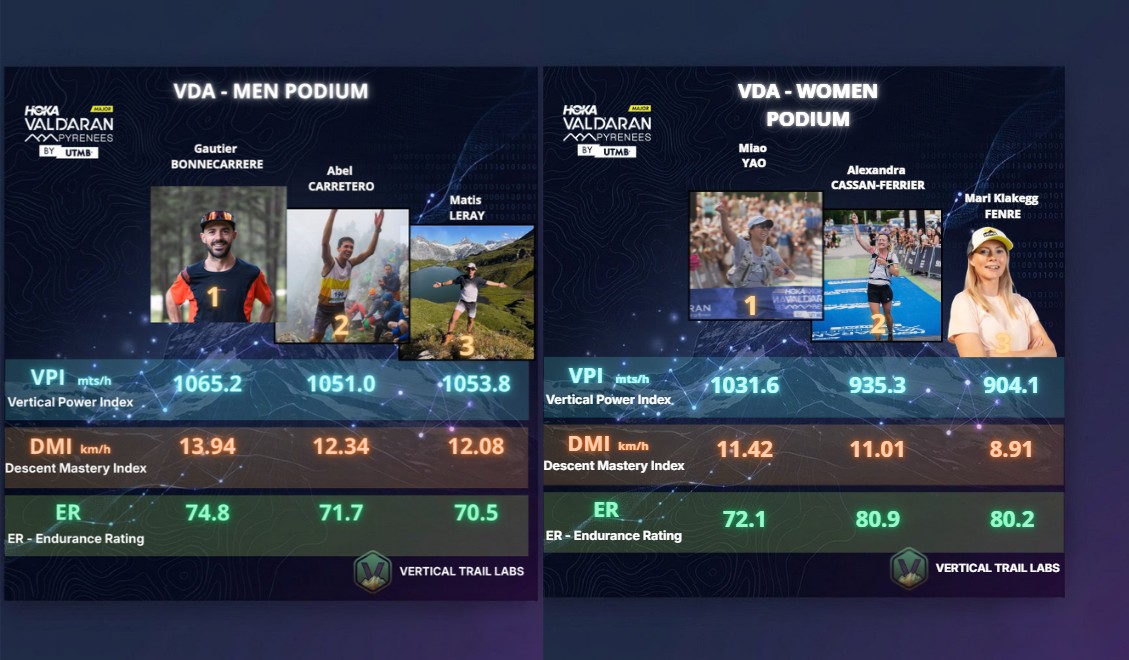
The men's race appeared to have a clear winner when Julien CALVO (1004) spent leading much of the day with one of the strongest climbing performances. However, a one-hour time penalty completely reshaped the final part of the race, handing victory to Gautier BONNECARRÈRE (1010) ahead of Abel CARRETERO (1008) and surprise podium finisher Matis LERAY (1024). The women's race produced one of the outstanding individual performances of the UTMB World Series season. Miao YAO (1001) dominated from the opening climb, won by almost one hour and finished eighth overall against the men's elite. Behind her, the battle for the podium remained competitive throughout the day, while Erola TORTADES (1597) quietly delivered one of the smartest pacing performances of the entire race to secure a remarkable tenth place despite posting one of the lowest climbing indices inside the Top 10.
As always, the Vertical Trail Labs metrics explain far more than the finishing times alone. VPI identifies climbing efficiency, DMI reveals descending performance, and ER exposes how effectively athletes managed fatigue over one of Europe's toughest mountain ultras.
Men's Race Analysis
Top 10
| Pos | Bib | Athlete | Time | VPI | DMI | ER | 1st Half Pace | 2nd Half Pace |
|---|---|---|---|---|---|---|---|---|
| 1 | 1010 | Gautier BONNECARRERE | 12:08:55 | 1109.0 | 12.67 | 74.8 | — | — |
| 2 | 1008 | Abel CARRETERO | 12:19:21 | 1096.8 | 12.17 | 71.7 | — | — |
| 3 | 1024 | Matis LERAY | 12:27:12 | 1092.0 | 12.04 | 70.5 | — | — |
| 4 | 1021 | Remy BRASSAC | 12:32:31 | 1082.2 | 12.27 | 71.6 | — | — |
| 5 | 1029 | Benjamin TREMONT | 12:42:02 | 1075.8 | 11.85 | 78.2 | — | — |
| 6 | 1004 | Julen CALVO VIGARA | 12:47:48 | 1000.7 | 12.28 | 62.2 | — | — |
| 7 | 1057 | Bastien ENJALBERT | 12:54:27 | 1043.3 | 11.92 | 74.7 | — | — |
| 8 | 1056 | Igor GOIKOLEA LARRAURI | 13:23:12 | 1024.4 | 11.0 | 71.9 | — | — |
| 9 | 1072 | Are FETVEIT | 13:34:58 | 993.0 | 11.41 | 76.7 | — | — |
| 10 | 1026 | Daniel LUQUE GONZALEZ | 13:55:43 | 969.6 | 11.0 | 71.9 | — | — |
The men's race revolved around one defining moment, but the checkpoint data tells a much richer story than the final classification. Julien CALVO (1004) was the strongest athlete on course for most of the day, repeatedly producing high VPIs while maintaining also a high DMI across the technical descents. That rare combination allowed him to control the race physically rather than tactically, opening small but steady advantages on every major climb. Although the one-hour penalty ultimately removed him from the top of the podium impacting his overall values, the Terrain Intelligence Engine still identifies him as one of the day's most complete performances.
The men's race revolved around one defining moment, but the checkpoint data tells a much richer story than the final classification. Julien CALVO (1004) was the strongest athlete on course for most of the day, repeatedly producing high VPIs while maintaining also a high DMI across the technical descents. That rare combination allowed him to control the race physically rather than tactically, opening small but steady advantages on every major climb. Although the one-hour penalty ultimately removed him from the top of the podium impacting his overall values, the Terrain Intelligence Engine still identifies him as one of the day's most complete performances.
Women's Race Analysis
Top 10
| Pos | Bib | Athlete | Time | VPI | DMI | ER | 1st Half Pace | 2nd Half Pace |
|---|---|---|---|---|---|---|---|---|
| 1 | 1001 | Miao YAO | 13:04:34 | 1031.6 | 11.42 | 72.1 | — | — |
| 2 | 1036 | Alexandra CASSAN-FERRIER | 14:01:37 | 966.1 | 10.85 | 80.9 | — | — |
| 3 | 1003 | Mari Klakegg FENRE | 14:25:16 | 951.5 | 10.11 | 80.2 | — | — |
If the men's race was remembered for its in-race penalty, the women's competition belonged entirely to Miao YAO (1001). From the opening climb she established a pace that no other woman could match, combining elite climbing efficiency with equally impressive descending to gradually extend her advantage throughout the day. Her VPI repeatedly exceeded 900 vertical meters per hour on the principal ascents, while her DMI remained among the strongest recorded by any athlete in the field. The result was not only a dominant women's victory but an extraordinary eighth-place finish in the overall classification against the men's elite.
What makes her performance even more remarkable is what happened during the final third of the race. Reports from post-race interviews and specialized trail media indicated that Miao YAO (1001) developed significant vision problems, most likely linked to the combination of extreme effort, prolonged heat exposure and accumulated fatigue. Despite these difficulties, she continued to increase her lead and comfortably secured victory by almost one hour. Her climbing technique also attracted widespread attention, with commentators highlighting how she attacked the steepest ascents without poles, driving herself forward by pushing directly on her quadriceps with both hands. Several broadcasters even remarked that camera operators struggled to keep pace with her on the steepest gradients.
Behind the winner, Alexandra CASSAN-FERRIER (1036) and Mari Klakegg FENRE (1003) approached the race very differently. Neither attempted to follow Miao Yao's aggressive climbing pace, instead focusing on maintaining sustainable effort across the course. Their VPIs remained below those of the winner, but both combined efficient descending with superior fatigue management during the hotter afternoon sections. As stronger early starters began to lose climbing efficiency, their disciplined pacing secured the remaining podium places.
One of the most fascinating performances came from Erola TORTADES (1597). Her VPI remained below 600 Vm/h for much of the race, making her one of the slowest climbers inside the women's Top 10 according to the Terrain Intelligence Engine. On climbing ability alone, very few observers would have predicted a top-ten finish. However, the full performance profile tells a completely different story. Erola recorded an ER of 71.0, one of the strongest endurance scores among the leading women. Her effort pace deteriorated from 4.81 min/Effort-km during the first half to 6.20 min/Effort-km in the second, representing substantially better fatigue control than many athletes who climbed considerably faster. Rather than chasing positions early, she maintained an exceptionally disciplined rhythm, steadily overtaking competitors as the race progressed. Her tenth-place finish stands as one of the clearest demonstrations that intelligent pacing can outweigh raw climbing speed over long mountain ultras.
Vertical Trail Labs Insights
The CDH offered another strong validation of the Terrain Intelligence Engine. Once again, the race confirmed that no single performance metric is sufficient to explain success over one hundred mountainous kilometers. Athletes who consistently combined high climbing efficiency (VPI), controlled descending (DMI) and limited performance decay (ER) occupied the highest positions regardless of individual split victories. Pure climbing power created opportunities, but complete terrain efficiency ultimately determined the final standings.
One of the clearest examples came from the women's race. Miao Yao (1001) combined elite climbing performance with remarkable endurance preservation, allowing her not only to dominate the women's field but also to finish eighth overall. Her achievement became even more extraordinary after post-race interviews and reports revealed that she experienced significant vision problems during the final third of the race, likely related to accumulated fatigue, heat stress and prolonged effort. Despite these difficulties, she maintained her pace on highly technical terrain and extended her lead to nearly one hour. Several specialized media outlets also highlighted her distinctive climbing technique, tackling the steepest ascents without poles and frequently pushing against her quadriceps with her hands, while live commentators noted that even the cameraman struggled to keep pace during some of the climbs.
Finally, the event reinforced another recurring observation from Vertical Trail Labs: environmental conditions often amplify differences between athletes more than terrain alone. While the penalty naturally dominated headlines, numerous post-race interviews pointed to the unusually warm conditions as one of the decisive factors shaping the second half of the race. Hydration, heat management and fatigue resistance became increasingly important after halfway, helping explain why several athletes with excellent early performances gradually lost ground.
The CDH therefore stands as another example that successful ultra-trail racing is not defined by isolated moments of speed, but by the ability to preserve efficiency under accumulating physiological stress across every hour of competition.