
Monterosa Walserwaeg - 120k - Pre-Race
Race Overview
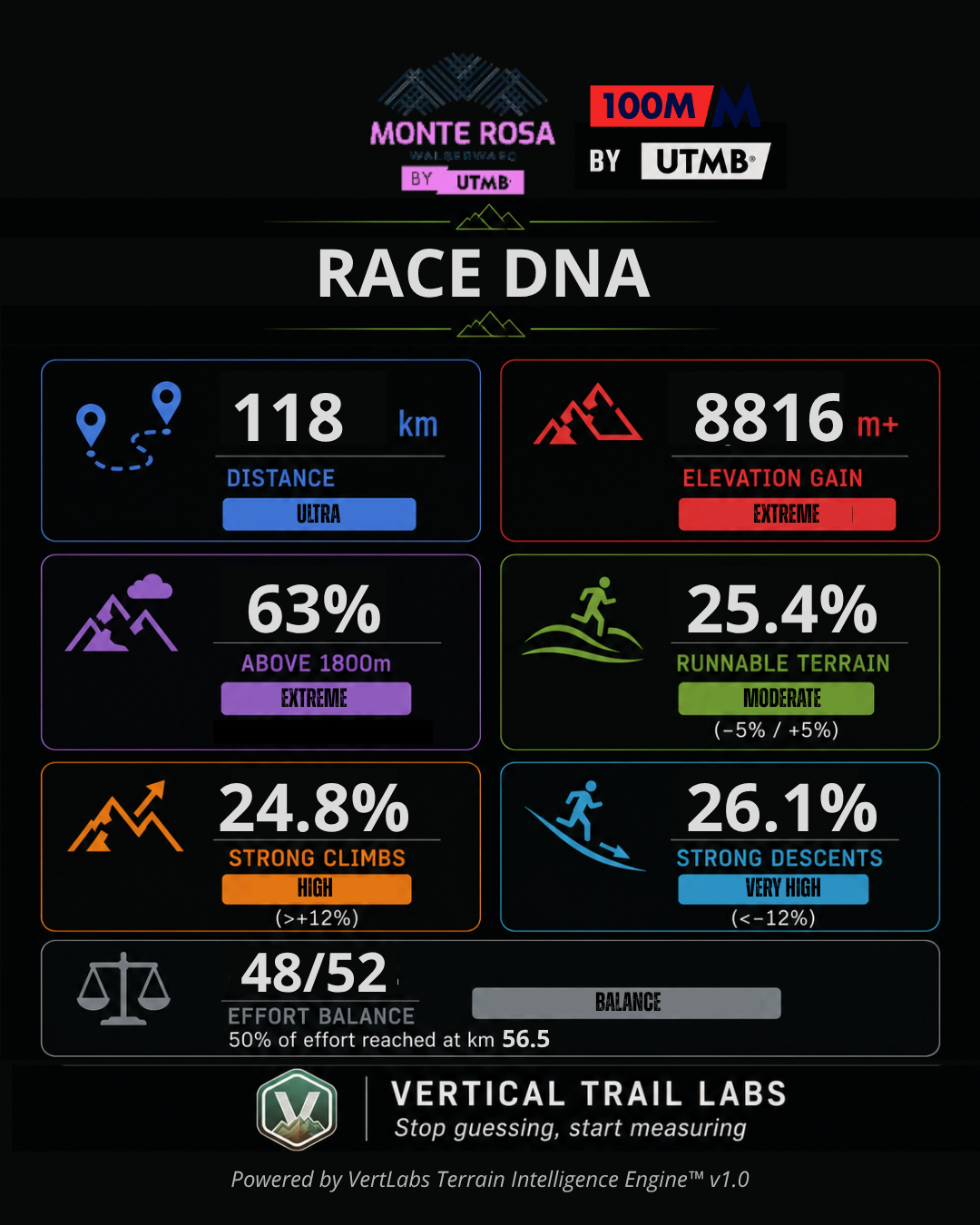
The Monterosa 120K is an exceptionally demanding mountain ultra defined by relentless vertical repetition at altitude. With 8,816 m+ over approximately 118 km, the course reaches a Vertical Density of 74.7 m+/km, the highest among the major races analyzed so far by Vertical Trail Labs. More than 63% of the course is above 1,800 m, while only 25.4% falls within rolling terrain, leaving relatively few opportunities to establish a sustained running rhythm.
The vertical load is also remarkably balanced between climbing and descending. 29.3 km (24.8%) are classified as Strong Climb and 30.8 km (26.1%) as Strong Descent. This means almost half of the race involves gradients beyond ±12%, creating a continuous cycle of high-force climbing and eccentric downhill loading.
The race starts aggressively: the first 19 km accumulate approximately 2,150 m+, immediately creating a major selection point. This is followed by a long descending phase before another substantial climbing block between approximately km 46 and 62, where the course adds around 1,690 m+. The pattern continues throughout the race rather than concentrating the difficulty into a single decisive ascent.
The final third is particularly demanding. After a long descent of approximately 1,346 m between km 86 and 98, runners face another 1,062 m+ climb after 100 km of racing, followed by further steep descending. The final descent reaches approximately −15.8%, making downhill efficiency critical when accumulated muscular fatigue is already very high.
Using the Vertical Trail Labs effort model, the 50% effort point occurs around km 56, producing an approximate 47/53 effort split. The course is therefore slightly front-loaded, largely because of the enormous opening climb, but the second half remains highly demanding rather than becoming progressively easier.
Biomechanical & Physiological Profile
Monterosa combines three major performance demands: high climbing power, eccentric durability and altitude endurance. The 74.7 m+/km Vertical Density requires repeated production of uphill force, while the 26.1% Strong Descent component means that efficient downhill mechanics are essential for preserving the legs. At the same time, 75.2 km above 1,800 m means that a large proportion of these efforts are performed under sustained altitude stress.
The course therefore rewards athletes who can repeatedly transition between steep climbing and descending without losing efficiency. Raw uphill ability alone is unlikely to be enough; the ability to recover from long descents and produce another strong climb deep into the race becomes increasingly important.
Vertical Trail Labs Insights
Monterosa stands out because its difficulty comes from the combination of several demanding characteristics rather than from one isolated feature. Its 74.7 m+/km Vertical Density is higher than VDA 160K (71.5), CDH 100K (64.1) and Lavaredo 120K (50.0), while its 63.7% altitude exposure is also the highest of these four races.
The result is a course with extreme vertical concentration, extreme altitude exposure, very low runnable terrain and almost equal amounts of severe climbing and descending.
Monterosa is not defined by one massive climb. It is defined by relentless vertical repetition at altitude.