
La Sportiva Lavaredo by UTMB - 80k– Pre-Race Analysis
Race Overview
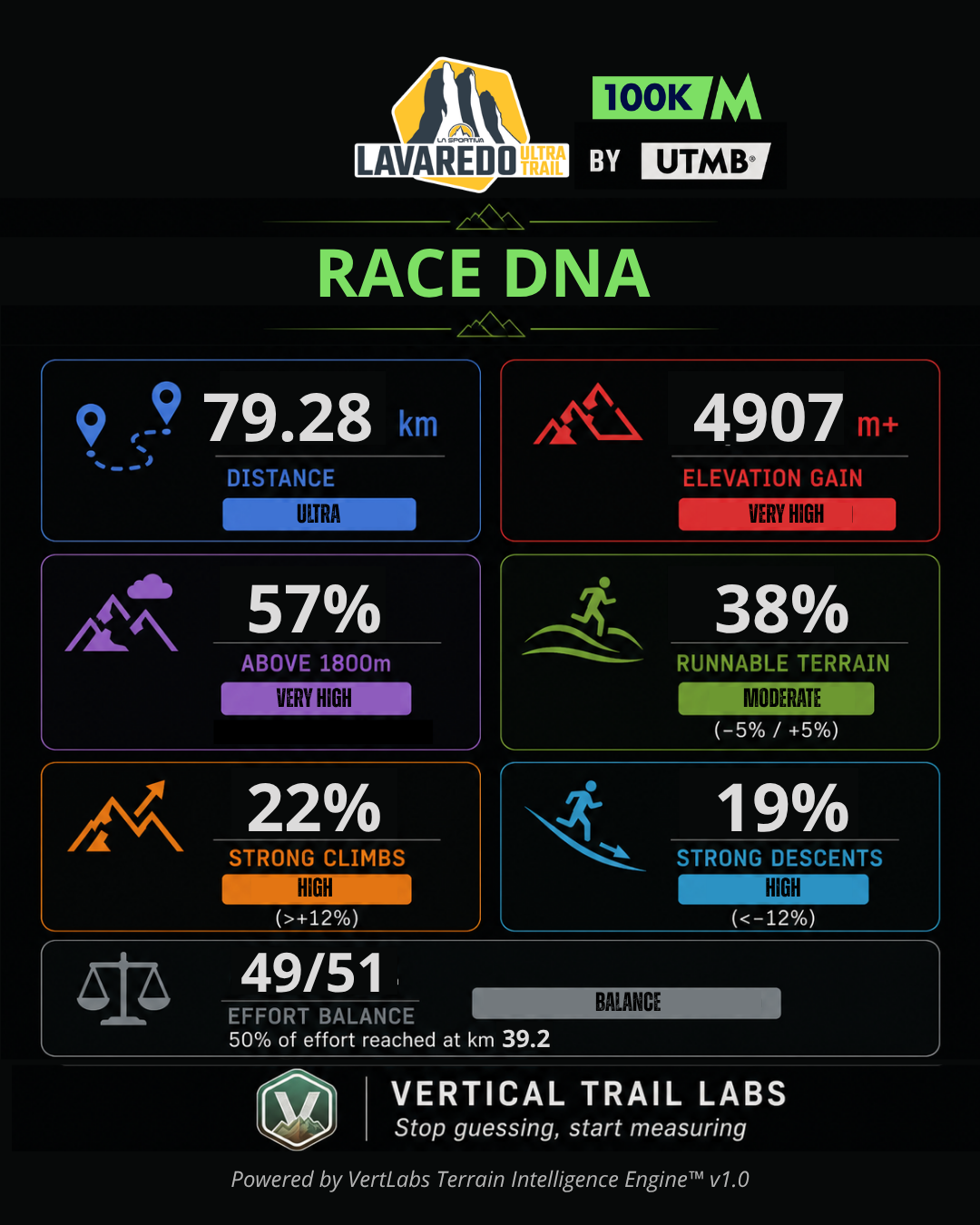
Despite being considerably shorter than the 120K, the Lavaredo 80K is more vertically concentrated.
With nearly 5,000 meters of climbing packed into just 79 kilometers, it reaches a Vertical Density of 61.9 m+/km, substantially higher than the 120K (50.0 m+/km). This means athletes encounter steeper terrain more frequently and have less distance over which to distribute the climbing effort.
The race also spends 57% of its distance above 1,800 meters, making altitude an even more influential performance factor than in the 120K.
Terrain Breakdown
Rolling Terrain (38%) Compared with the 120K, the 80K offers noticeably more runnable terrain.
These rolling sections provide valuable recovery opportunities between the major climbs and allow stronger runners to maintain a higher average speed.
Strong Climbs (22%) Steep climbing is the defining feature of this race.
The opening 11 km gain an extraordinary 1,677 vertical meters, averaging more than 14%, immediately forcing most competitors into hiking mode.
Additional steep climbing blocks around km 48–60 maintain the pressure throughout the second half.
Unlike the 120K, where climbing is spread across many medium ascents, the 80K contains fewer but more concentrated uphill efforts.
Strong Descents (19%) Although downhill demand is slightly lower than the climbing load, nearly one fifth of the course exceeds −12%.
The final descent from approximately km 68 to the finish averages more than 16% downhill, creating a decisive eccentric challenge when fatigue is already high.
Altitude Exposure One of the defining characteristics of the Lavaredo 80K is its prolonged time spent at altitude.
With 57% of the course above 1,800 meters, athletes remain in reduced-oxygen conditions for much of the race, increasing aerobic stress while reducing recovery capacity between climbs.
Effort Distribution
The race exhibits an almost perfectly balanced workload (49 / 51).
Although the opening climb is extremely demanding, the remaining course continues to alternate between climbs and descents, preventing any meaningful reduction in physiological demand.
Energy management remains essential from start to finish.

Vertical Trail Labs Insights
Extremely Concentrated Vertical Load At 61.9 m+/km, the 80K is considerably steeper than the 120K despite accumulating less total elevation gain.
Early Selection The first 11 kilometers represent the race's defining selection point.
Athletes who exceed sustainable climbing intensity here are likely to pay for that effort throughout the remainder of the event.
High-Altitude Racing More than half the course remains above 1,800 meters, making pacing and aerobic efficiency critical from the opening hour.
Fast Doesn't Mean Easy Although the race contains more runnable terrain than the 120K, its higher vertical density makes each kilometer mechanically more demanding.