
CCC 100K — Pre-Race Analysis
Race Overview
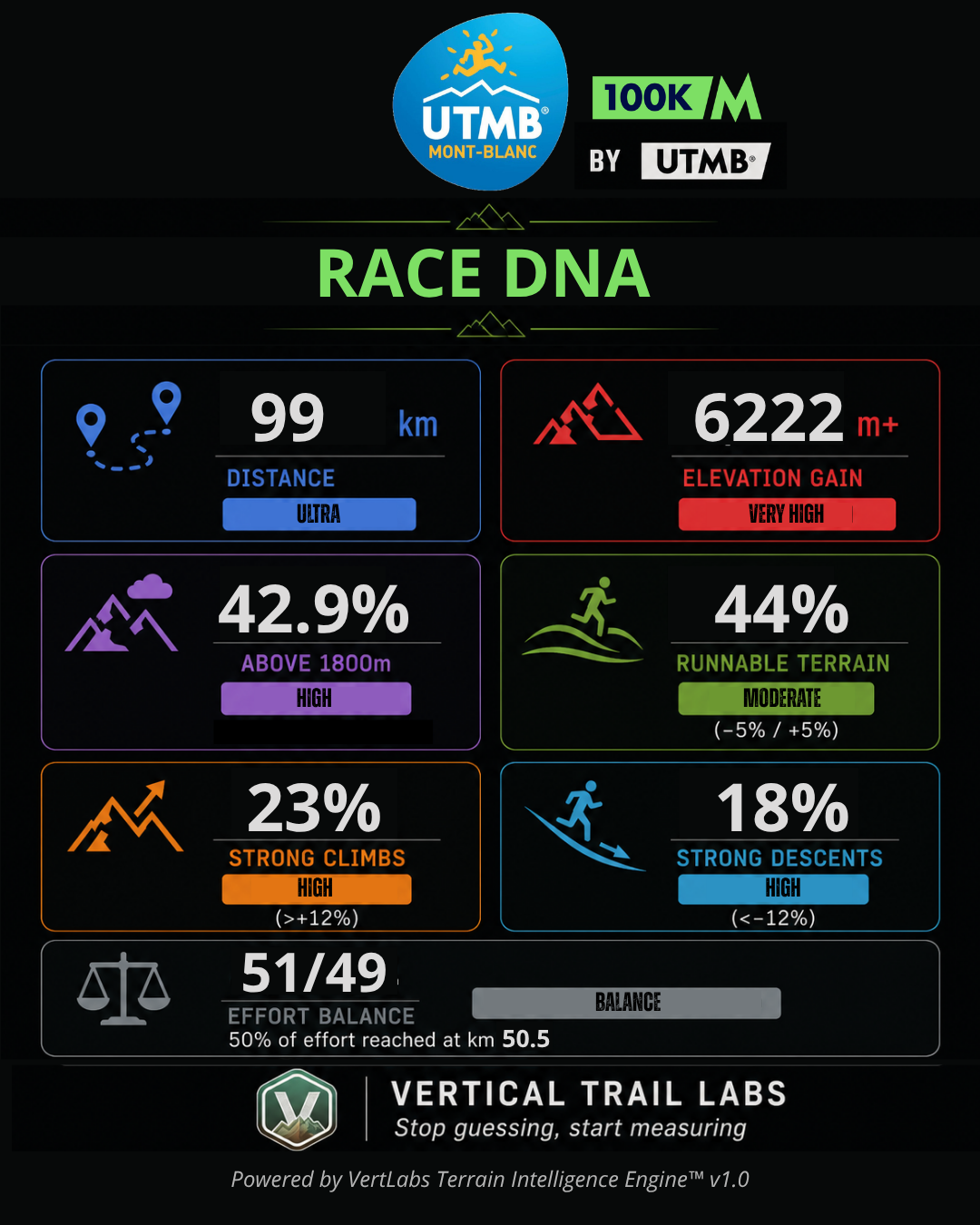
The CCC is a deceptively runnable 100K with a very high vertical load. At 62.5 m+/km, the course does not reach the extreme vertical concentration of Monterosa 86K or 120K, but the combination of 6,222 m+, 23.5% Strong Climb and 18.4% Strong Descent creates a race where climbing ability remains a major determinant while the relatively high amount of rolling terrain provides more opportunities to run.
The course begins with an immediate transition into the high mountains. From Courmayeur, runners climb rapidly toward 2,500 m, reaching the Grand Col Ferret area early in the race. The first major ascent is therefore not just a vertical challenge: it also introduces altitude very early. The official course description confirms that the opening kilometers quickly take runners above 2,500 m before crossing into Switzerland.
The profile then creates a characteristic CCC rhythm: major climb → long descent → rolling/high-altitude terrain → another major climb. The first two major peaks occur around km 9–10 and km 30, both reaching approximately 2,500 m. Between them, however, there is substantial runnable terrain rather than continuous steep climbing. This makes CCC more rhythm-dependent than Monterosa: runners need to know when to hike, when to climb efficiently and, crucially, when to actually run.
The First Half
The opening climb is one of the most obvious strategic traps.
The course rises from roughly 1,200 m to more than 2,500 m in the first 10 km, with the strongest climbing concentrated in the latter part of the ascent. Going too aggressively here can produce a deceptively good first checkpoint while creating unnecessary fatigue for the long sequence that follows.
After the first summit, the course drops and then spends a considerable amount of time around 1,800–2,100 m before the second major climb around km 27–31. This second ascent is another major vertical effort, again reaching approximately 2,500 m.
The important point is that CCC doesn't simply become progressively harder. Instead, it repeatedly asks the athlete to recover, run, climb again and descend again.
The Middle Section — Where the Race Changes
Around km 35–60, the profile loses altitude progressively, eventually reaching its lowest point around km 50 before climbing again.
This is potentially the most important running section of the race.
With 44% of the course classified as rolling terrain, CCC offers considerably more opportunity to run than the Monterosa races. The athletes who can maintain efficient running on these moderate sections without turning them into unnecessarily hard efforts can potentially gain significant time.
This is where CCC becomes less about pure vertical power and more about terrain management.
The race then reaches another significant climbing sequence around km 60–66, followed by a descent toward km 70. From there, the course climbs again around km 73–77, before entering the final section toward Chamonix.
The Final 25 km
The final quarter is not simply a downhill run to Chamonix.
After the climb around km 73–77, the course continues with several changes of gradient. There is another notable uphill section around km 88–92, followed by a final descent toward the finish.
This means the athlete reaches the final 10–15 km having already absorbed more than 6,000 m of climbing and a substantial amount of downhill loading.
The final section therefore rewards preserved running economy more than raw climbing power. If the legs remain functional, the relatively runnable terrain can allow a strong athlete to accelerate toward Chamonix. If the earlier descents have caused excessive muscular damage, that opportunity disappears.
Altitude
42.64 km — 42.9% of the course — are above 1,800 m.
This places CCC firmly in the Very High altitude exposure category, although it is considerably less altitude-dominant than Monterosa 120K.
The important characteristic is early exposure: the athlete reaches approximately 2,500 m during the first major climb, rather than gradually entering altitude late in the race. The Grand Col Ferret itself is at 2,537 m.
Altitude therefore interacts with pacing from the beginning rather than becoming a late-race problem.
Biomechanical Profile
CCC has an interesting balance:
23.4 km Strong Climb 18.4 km Strong Descent 44.0 km Rolling Terrain
That combination makes it fundamentally different from Monterosa.
Monterosa is dominated by repeated steep mechanical cycles. CCC gives the athlete considerably more space to run between those cycles.
The key performance skill is therefore not simply climbing speed. It is the ability to transition efficiently between:
steep climb → technical descent → runnable terrain → climb again
without allowing any one mode to create excessive fatigue.
Vertical Trail Labs Outlook
The CCC sits in an interesting position within the races we've analyzed. Its 62.5 m+/km is substantially less vertically concentrated than Monterosa 86K (76.0 m+/km) and Monterosa 120K (74.7 m+/km), but its 44% rolling terrain gives runners considerably more opportunity to exploit running efficiency.
That makes CCC a more balanced mountain ultra: still highly vertical, still strongly influenced by climbing, but with a much greater premium on the ability to maintain speed across runnable terrain.
CCC is not won by climbing the fastest. It is won by losing the least efficiency between the climbs.