
La Sportiva Lavaredo Ultra Trail - 120k - Pre Race
Race Overview
The La Sportiva Lavaredo Ultra Trail 120K is deceptive.
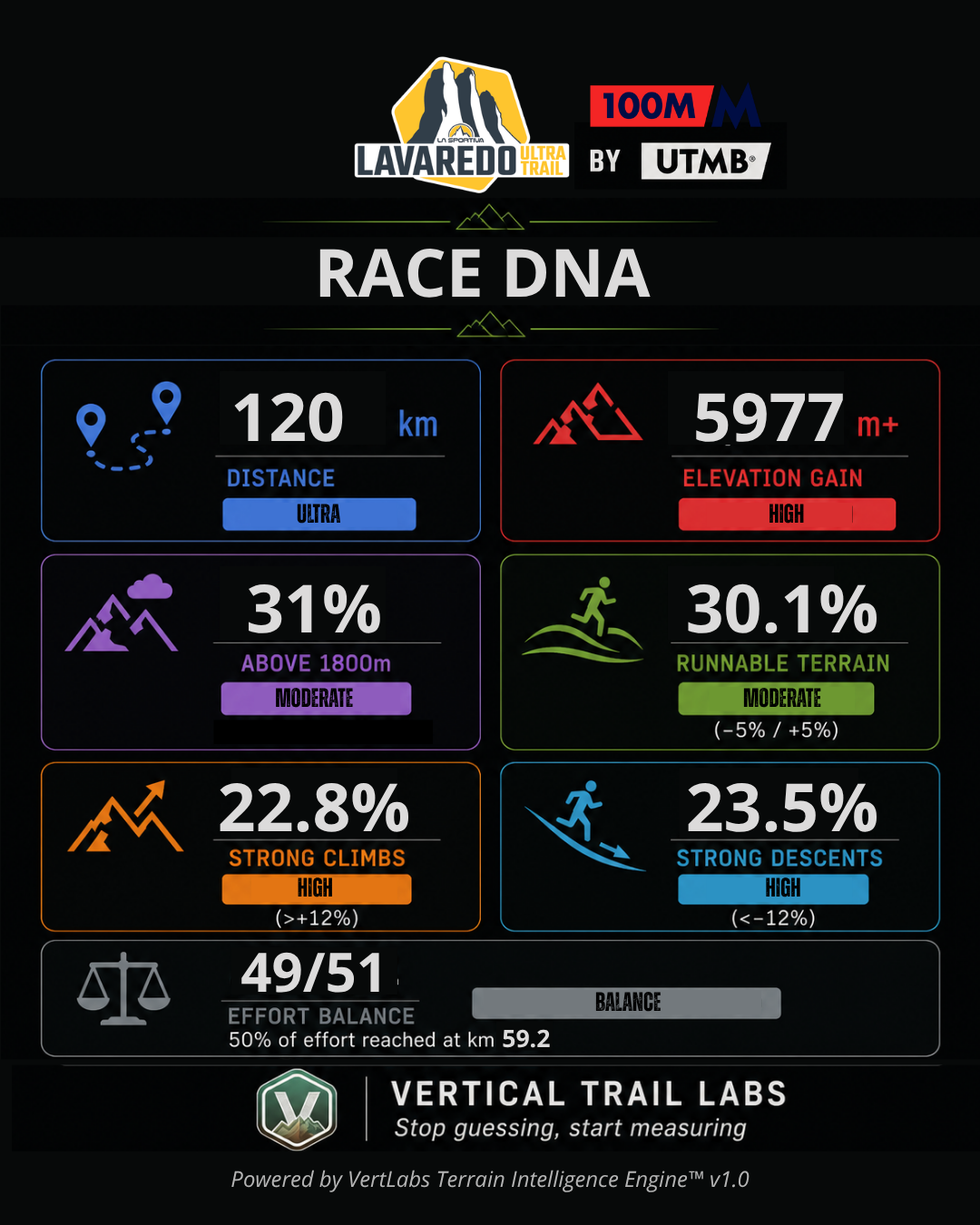
Its 5,977 meters of climbing may appear modest compared to races like Val d'Aran or UTMB, but the course compensates with continuous terrain changes, repeated steep climbs and descents, and nearly 58 kilometers above 1,800 meters.
Unlike races dominated by one or two massive ascents, Lavaredo spreads its difficulty across the entire course, forcing runners to repeatedly change movement patterns while maintaining efficiency for nearly 120 kilometers.
Only 30% of the route qualifies as runnable terrain, meaning athletes spend almost 70% of the race climbing or descending.
Biomechanical Profile
Lavaredo alternates continuously between:
steep hiking, technical descending, short runnable transitions.
This frequent change in locomotion prevents muscular specialization and progressively increases biomechanical fatigue.
Success depends less on producing one exceptional climbing performance and more on maintaining movement efficiency through dozens of terrain transitions.
The race particularly rewards athletes with:
consistent climbing power, economical downhill mechanics, excellent fatigue resistance over long durations.
Terrain Breakdown
Rolling Terrain (30%)
The race provides relatively few sustained runnable sections.
Most rolling terrain appears between major climbs, offering short opportunities to recover before the next biomechanical demand.
Unlike flatter mountain ultras, Lavaredo rarely rewards constant running rhythm.
Strong Climbs (19%)
Steep climbs account for almost one fifth of the course.
The race avoids one enormous ascent and instead presents multiple climbs between 600 and 900 vertical meters, progressively accumulating fatigue.
The major climbing blocks occur around:
km 20–26 km 46–53 km 69–73 km 88–92 km 98–101
Rather than one decisive climb, Lavaredo demands repeated high-power efforts throughout the day.
Strong Descents (20%)
Downhill running is equally important.
Nearly 24 km exceed −12%, producing sustained eccentric loading on the quadriceps.
The long descents following the high Dolomite passes gradually increase muscular fatigue before the final section.
Athletes capable of descending efficiently without excessive braking will preserve considerably more energy for the closing kilometers.
Altitude Exposure
One of Lavaredo's defining characteristics is altitude.
The course spends 57.3 km (48%) above 1,800 meters, meaning almost half the race takes place where oxygen availability begins to noticeably reduce aerobic performance.
Unlike alpine races that briefly cross high passes, Lavaredo repeatedly returns above this elevation throughout the event, preventing complete physiological recovery.
Effort Distribution
Unlike Val d'Aran or CDH, Lavaredo exhibits an almost perfectly balanced workload.
The climbing demand is distributed across the entire course rather than concentrated early or late.
This produces a race where pacing mistakes remain costly from start to finish.
Athletes cannot simply "survive the first half" or "save themselves for the end"; energy management must remain consistent over nearly 120 kilometers.
Vertical Trail Labs Insights
Balanced Mountain Ultra
Unlike front-loaded mountain races, Lavaredo distributes its workload remarkably evenly.
The decisive factor becomes endurance rather than explosive climbing ability.
Terrain Never Relaxes
Although the total climbing is lower than many Alpine ultras, the constant alternation between climbs and descents prevents prolonged recovery.
Mechanical fatigue accumulates continuously.
Altitude Remains Relevant
Nearly half the course exceeds 1,800 meters, increasing physiological stress while amplifying pacing errors.
Downhill Economy Matters
The ratio between steep climbs and steep descents is almost identical (19.1% vs 19.7%).
Athletes who descend efficiently will likely gain more cumulative time than those relying solely on uphill strength.