
Wild 110 Crans-Montana - Pre Race Analysis
WILDSTRUBEL 110 — Pre-Race Analysis
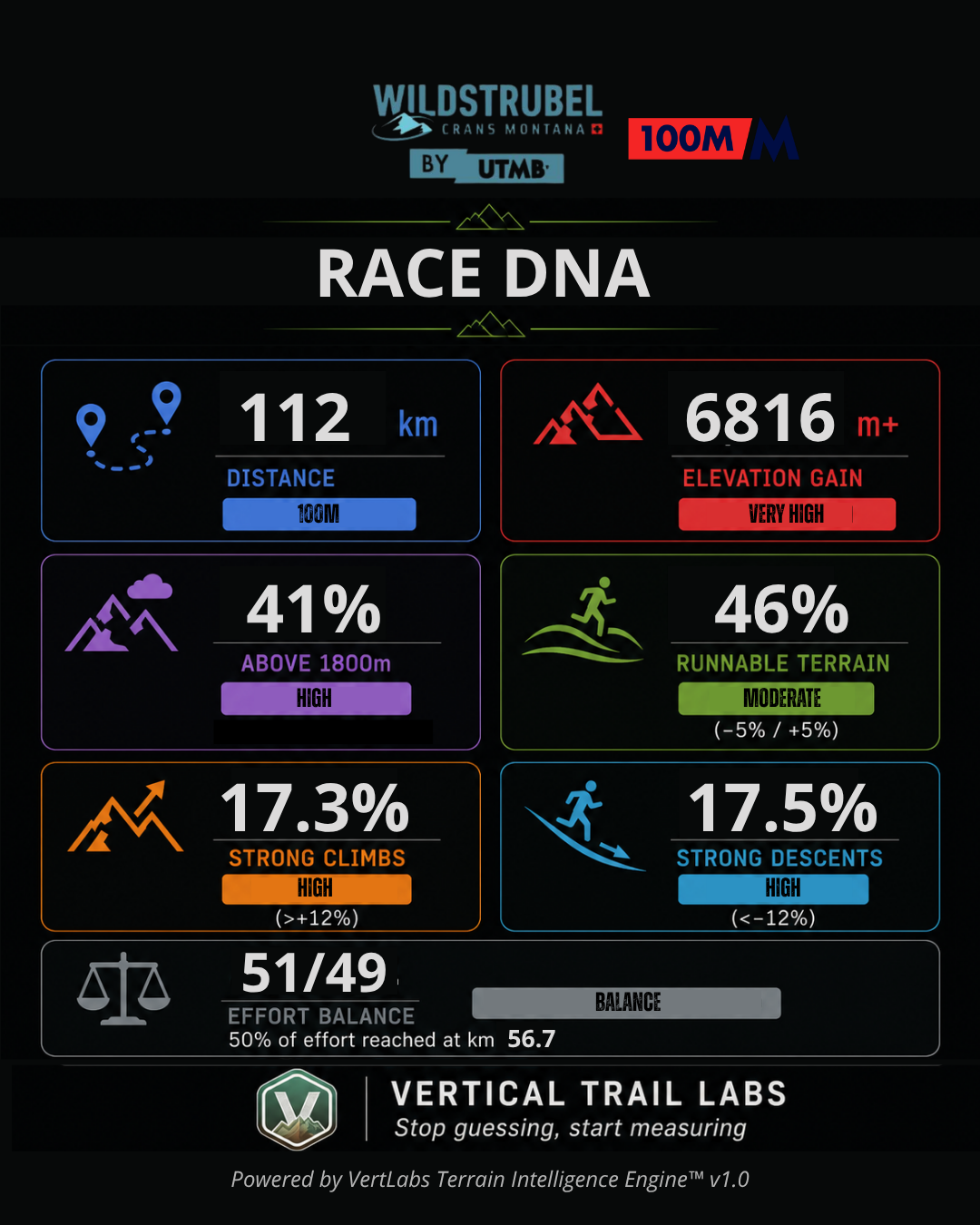
The Wildstrubel 110 is a high-mountain ultra built around long climbing blocks, substantial descents and repeated exposure above 1,800 m. The Vertical Trail Labs engine measures approximately 112 km and 6,816 m+, producing a Vertical Density of 60.9 m+/km. That places the race in the Very High vertical-load category, but its defining characteristic is the way that vertical is distributed across the course rather than an exceptionally high density alone.
Around 41% of the course sits above 1,800 m, while 46% is classified as Rolling Terrain. This creates an interesting contrast: almost half the race offers relatively runnable terrain, yet the course repeatedly interrupts that rhythm with major alpine climbs and descents. 17.3% is Strong Climb and 17.5% Strong Descent, meaning more than a third of the race is exposed to gradients beyond ±12%.
The opening section is already significant. From Crans-Montana, the course builds progressively before reaching its first major mountain block around km 7–12, climbing toward approximately 2,300 m. After the initial descent, runners encounter another substantial climb around km 20–30, reaching approximately 2,500 m. The profile therefore introduces serious altitude and vertical demand relatively early, before the race has even reached its central section.
This early sequence is important because it leads into one of the longest descending sections of the race. From around km 30 toward km 36–40, the course loses a large amount of elevation before beginning another major climbing phase. The result is a classic Wildstrubel pattern: climb high, descend deeply, then rebuild vertical again.
The most significant climb appears around km 44–50, where the profile rises rapidly toward the race's highest point, close to 2,800 m. This is not just another climb: the official course identifies the Wildstrubel Hut at 2,800 m as the highest point of the race. This section should be one of the major physiological and strategic landmarks of the race.
After the high point, the course descends through another extended mountain section before entering a more rolling middle-to-late race. However, the race is far from finished. The profile continues to produce several significant climbs around km 62–67, km 72–76 and km 88–94, meaning that the final third still contains meaningful vertical work.
This is where Wildstrubel becomes particularly interesting from a fatigue perspective. The athlete does not get a long, uninterrupted downhill to the finish. Instead, the course repeatedly asks for another climb after substantial accumulated descending. By this point, downhill durability becomes almost as important as climbing power.
The official route reinforces this structure. After crossing the Gemmi Pass at 2,268 m, runners travel through the Bernese Oberland toward Kandersteg, Adelboden and Lenk before reaching the Wildstrubel massif. The return toward Crans-Montana includes the Rawyl Pass at 2,427 m and the final section along the Bisse du Ro.
Effort Distribution
The engine places the 50% effort point at approximately km 56.7, producing a 51/49 effort balance.
This is an almost perfectly balanced race from an effort perspective. The first half is not disproportionately difficult despite the early high-altitude climbs, but neither does the second half become dramatically harder. Instead, Wildstrubel maintains a relatively constant demand across the entire course.
That makes pacing discipline particularly important. The first major climbs can look spectacular on the profile and invite aggressive racing, but the course still contains several substantial climbs after km 60 and into the final quarter.
Biomechanical Profile
Wildstrubel's signature is the combination of 17.3% Strong Climb + 17.5% Strong Descent.
The balance is almost perfect.
This means the race places similar demands on the muscles responsible for producing uphill force and absorbing downhill impact. The strongest athletes will therefore need more than good climbing speed: they need to preserve downhill mechanics sufficiently to climb efficiently again later.
The 46% Rolling Terrain is equally important. These sections represent the opportunity to recover and make time, but they can also become a trap. Running them too aggressively increases metabolic cost; running them too conservatively wastes one of the few parts of the course where speed can be maintained relatively efficiently.
The Strategic Sections
KM 0–30 — Build, don't burn. The opening climbs introduce altitude early, with two significant ascents before km 30. The goal should be to establish an efficient rhythm rather than race every gradient.
KM 30–50 — The first major test. After a substantial descent, the course climbs toward the Wildstrubel high point. The ascent toward approximately 2,800 m is likely to be one of the defining sections of the race.
KM 50–75 — Fatigue begins to compound. The long descent after the high point provides relief from climbing but creates significant eccentric load. Several subsequent climbs mean that downhill efficiency becomes increasingly important.
KM 75–95 — The late-race mountain sequence. The course continues to rise and fall rather than simply descending toward the finish. The Rawyl section and the subsequent terrain ensure that the race remains mechanically demanding deep into the second half.
Final section — Run what the legs give you. The final terrain becomes more runnable, but after 6,000+ m of accumulated climbing and extensive descending, the ability to convert runnable terrain into speed will depend heavily on how well the athlete has protected their legs earlier.
Vertical Trail Labs Verdict
Wildstrubel 110 is a race of repetition, not one decisive climb.
Its 60.9 m+/km Vertical Density, 41% altitude exposure, 17.3% Strong Climb, 17.5% Strong Descent and almost perfectly balanced 51/49 effort distribution create a course where efficiency has to be maintained for the entire loop.
The race's biggest challenge is the repeated transition between high-altitude climbing, long descending and runnable terrain. The athlete who climbs well but destroys their legs on the descents will pay for it later; the athlete who descends efficiently and protects their running economy can continue producing speed deep into the second half.
The official route's passage through Gemmi (2,268 m), the Wildstrubel high point at 2,800 m and Rawyl (2,427 m) gives the race a particularly strong high-mountain character.
The Wildstrubel Race DNA: high-altitude exposure, balanced climb/descent demands, substantial runnable terrain, and a course that keeps asking for another mountain long after the first major summit.