
Val d'Aran by UTMB- CDH 110km - Pre Race Analysis
Race Overview
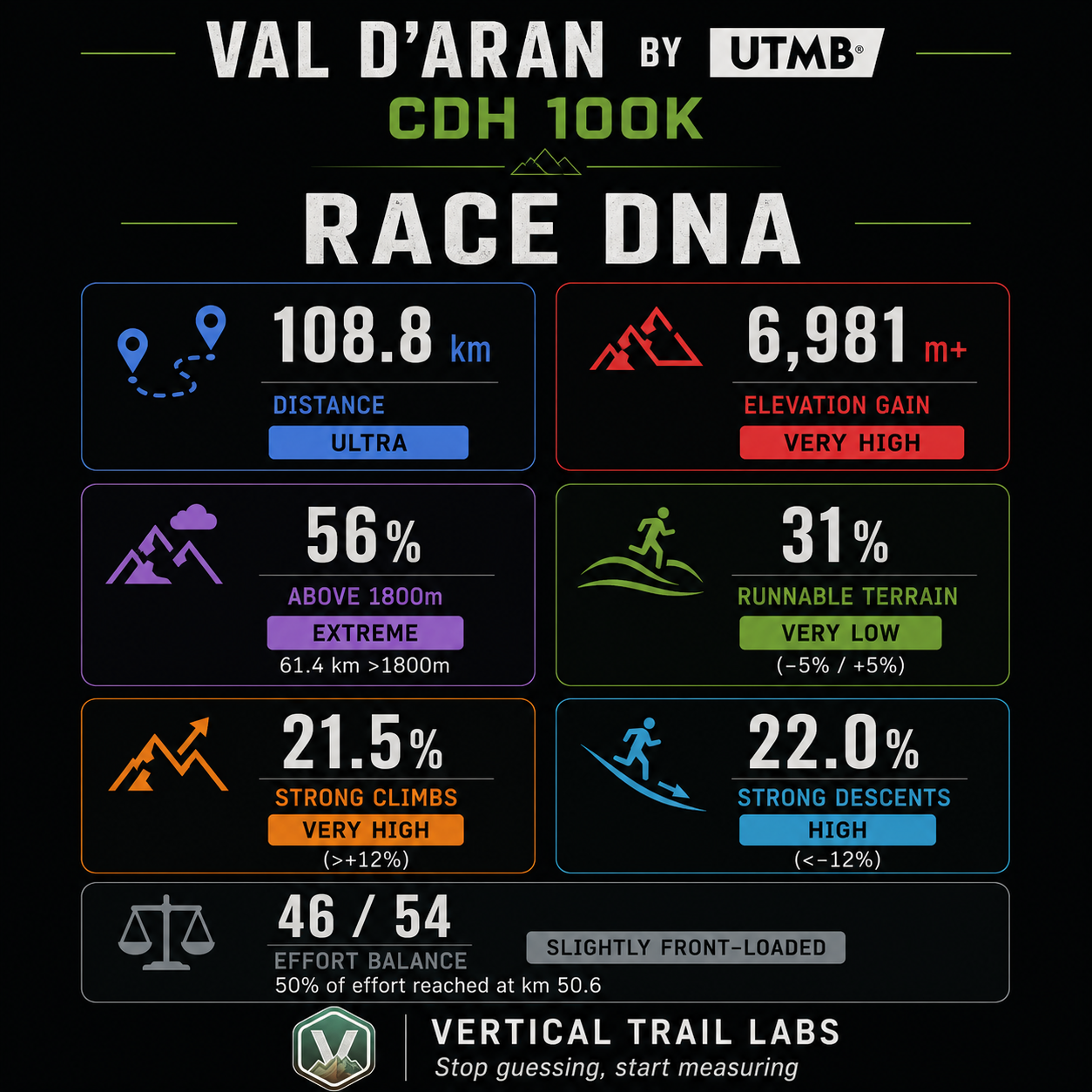
The CDH 100Km packs nearly 7,000 meters of climbing into just 109 kilometers, producing one of the highest vertical densities event. Unlike flatter ultras where efficiency comes from sustained running speed, success here depends on managing repeated transitions between steep climbing, technical descending and long periods at altitude.
Only 31% of the course can truly be classified as rolling terrain, meaning athletes spend almost 70% of the race either climbing or descending. The terrain continuously interrupts rhythm, forcing competitors to alternate between hiking, climbing and technical downhill running.
Another defining characteristic is altitude. More than 61 km are raced above 1,800 meters, meaning over half the event occurs where oxygen availability begins to noticeably affect aerobic performance. This increases physiological cost while making pacing errors significantly more expensive than at lower elevations.
Terrain Breakdown
Rolling Terrain (31%) Although roughly one third of the course falls between ±5% slope, these sections rarely become fast runnable terrain. Most act as transition corridors connecting the major climbs and descents, providing brief opportunities to recover before the next major effort.
Strong Climbs (21.5%) Nearly one quarter of the race exceeds 12% gradient, demanding sustained hiking power rather than running economy.
The defining ascent occurs between km 96 and km 102, averaging almost 18%, arriving after more than 90 km of accumulated fatigue. This final climb will likely decide positions throughout the field.
Earlier, the massive climb from km 13 to km 23 gains over 1,500 vertical meters, immediately placing a substantial metabolic load on the athletes.
Strong Descents (22%) Steep descents account for virtually the same proportion as steep climbs.
The final descent (km 104–110) averages more than 20% downhill, making it one of the most biomechanically demanding sections of the race. By this stage, quadriceps fatigue and eccentric muscle damage become major limiting factors.
Rather than rewarding pure downhill speed, these descents reward runners capable of preserving neuromuscular control late in the race.
Effort Distribution
One of the most interesting characteristics of TDL is its 46 / 54 effort distribution. Although athletes reach 50% of the physical distance at approximately km 54, they reach 50% of the race's total physiological workload at km 50.6.
The second half still contains:
over 2,900 meters of climbing the decisive final ascent the steepest downhill of the entire course In practice, the first half determines how much fatigue athletes carry, while the second half determines how effectively they can continue producing climbing power.
Biomechanical Profile
From a mechanical perspective, CDH alternates between three dominant movement patterns:
sustained uphill hiking requiring high concentric force production; long excentric braking phases during technical descents; relatively short recovery sections where athletes can restore rhythm. Because runnable terrain is limited, the race rarely allows competitors to settle into economical running mechanics. Instead, muscular fatigue accumulates through repeated changes in movement strategy.
This favors athletes with:
exceptional uphill power (high VPI), efficient downhill technique (high DMI), minimal late-race performance decay (high ER).
Vertical Trail Labs Insights
Several characteristics distinguish CDH from a typical 100K mountain ultra.
Very HighVertical Density
At over 64 m+/km, climbing demand remains consistently high throughout the race, rewarding athletes capable of producing sustainable vertical speed rather than fast flat running.
Altitude Becomes a Performance Multiplier
With 56% of the course above 1,800 meters, oxygen limitation amplifies pacing mistakes. Conservative early pacing becomes increasingly valuable.
Late-Race Decision Point
The climb between km 96–102 represents the defining obstacle of the event. Athletes arriving there with preserved climbing capacity can gain substantial time before the final descent into Vielha.
Descending Cannot Be Ignored
Nearly one quarter of the race consists of steep downhill terrain. Even the strongest climbers risk losing significant time if excentric fatigue compromises descending efficiency during the final hour.
CDH rewards athletes capable of combining climbing power, downhill efficiency and fatigue resistance, making it an ideal race to evaluate the three Vertical Trail Labs performance indices: VPI, DMI and ER.