
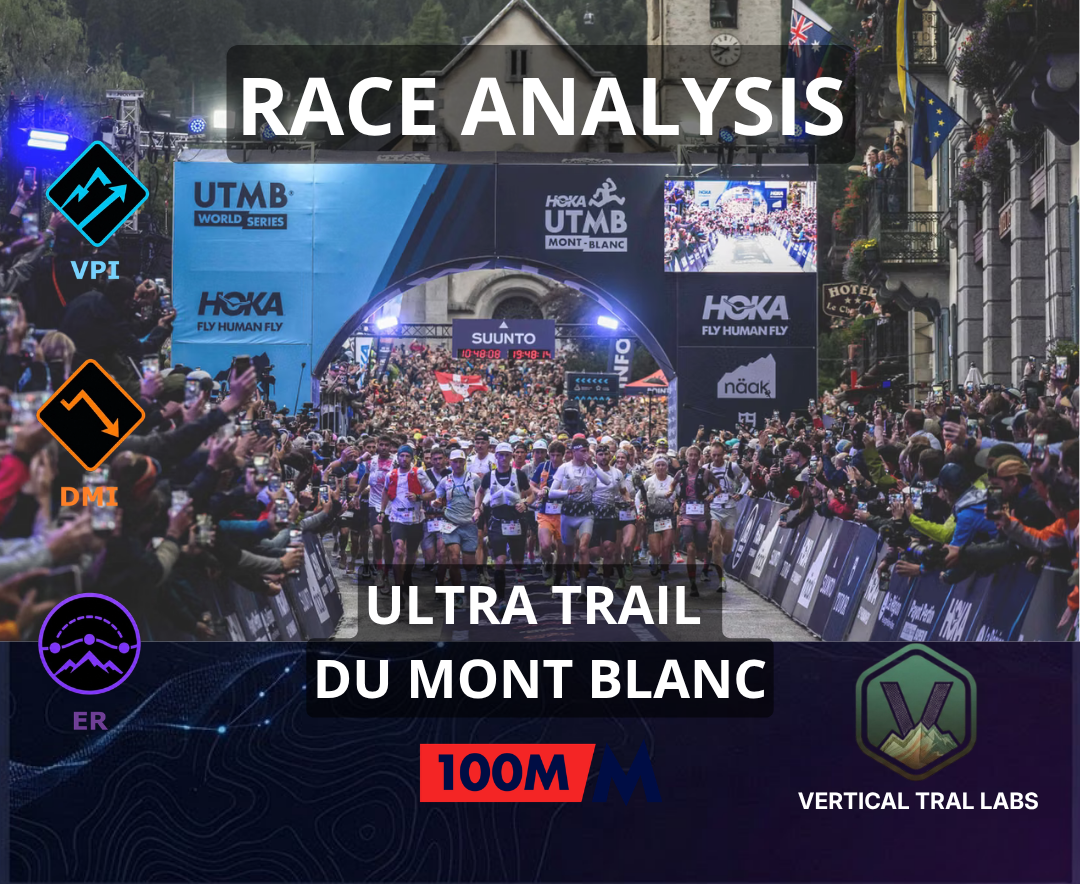
UTMB 2026 — Race Analysis
Race Overview
The 2026 UTMB started under unusual circumstances. Forecast thunderstorms forced a two-hour delay, and the course was modified to avoid the exposed Pyramides Calcaires section in Italy. The final route was around 174 km with approximately 9,700 m of climbing. Consequently, although Dhiman's 18:16:29 was the fastest time ever recorded at UTMB, the course was different from the standard route.
The men's race quickly became a demonstration of control. Baptiste Chassagne led through Les Contamines, but Dhiman moved into the lead around 36–41 km and began creating separation. At Les Chapieux he already had roughly seven minutes over Chassagne; at Lac Combal the advantage had grown to 14 minutes, and by Grand Col Ferret it was around 22 minutes. From there, the race for victory was essentially over.
The battle behind him was much more dynamic. Caleb Olson, eighth at Courmayeur, gradually moved through the field, passing runners at almost every major checkpoint before overtaking Joaquín López and eventually closing dramatically on Chassagne. At the finish, only 46 seconds separated second and third. Meanwhile, Virgile Moriset produced one of the strongest second-half progressions of the entire race, climbing from 20th around Lac Combal to fourth at the finish.
The women's race followed a different pattern. L’Hirondel and Rachel Entrekin established themselves as the main protagonists, with Lucy Bartholomew briefly taking the lead around Les Contamines. L’Hirondel regained control and gradually extended her advantage after Courmayeur. Behind her, Emily Schmitz came alive in the second half, moving from seventh at Courmayeur to fifth at Bertone, fourth at Arnouvaz and ultimately third. Jazmine Lowther produced another spectacular late progression, moving from 14th at Courmayeur to fifth at the finish.
That difference between early dominance and late progression is central to the VTL reading of this race.
Men’s Race Analysis
Top 10
| Pos | Dorsal | Corredor | Tiempo | VPI | DMI | ER | Ritmo 1ª Mitad | Ritmo 2ª Mitad |
|---|---|---|---|---|---|---|---|---|
| 1 | 6 | Ben DHIMAN | 18:16:29 | 1131.7 | 14.35 | 81.1 | 3.57 min/km | 4.24 min/km |
| 2 | 25 | Baptiste CHASSAGNE | 18:47:38 | 1104.5 | 13.92 | 83.7 | 3.71 min/km | 4.32 min/km |
| 3 | 8 | Caleb OLSON | 18:48:24 | 1096.0 | 13.96 | 86.3 | 3.76 min/km | 4.28 min/km |
| 4 | 101 | Virgile MORISET | 19:00:23 | 1092.3 | 13.68 | 88.5 | 3.85 min/km | 4.29 min/km |
| 5 | 41 | Joaquin LOPEZ | 19:06:48 | 1089.7 | 13.48 | 81.7 | 3.74 min/km | 4.43 min/km |
| 6 | 10 | Hannes NAMBERGER | 19:13:51 | 1069.8 | 13.7 | 82.0 | 3.77 min/km | 4.45 min/km |
| 7 | 73 | Gautier BONNECARRERE | 19:23:16 | 1072.0 | 13.43 | 78.6 | 3.74 min/km | 4.54 min/km |
| 8 | 43 | Antoine CHARVOLIN | 19:40:33 | 1062.5 | 13.0 | 77.1 | 3.77 min/km | 4.63 min/km |
| 9 | 51 | Yannick NOËL | 19:51:42 | 1045.7 | 13.09 | 79.9 | 3.85 min/km | 4.63 min/km |
| 10 | 53 | Jean-Philippe TSCHUMI | 19:58:24 | 1040.1 | 12.97 | 74.3 | 3.78 min/km | 4.75 min/km |
The first thing that jumps out is how compressed the men's elite field was behind Dhiman. The entire Top 10 occupied only 1:41:55, with positions 2 through 10 separated by barely more than 70 minutes. Yet within that relatively narrow finishing range, the VTL metrics reveal very different performance profiles.
Ben DHIMAN (Bib 6) was the clear outlier in terms of raw performance. His VPI of 1131.7 was the highest in the Top 10, as was his DMI of 14.35. He also recorded the fastest first-half pace at 3.57 min/effort-km. This is important because his victory was not produced by simply pacing conservatively and surviving better than everyone else. Dhiman generated the highest uphill power, the highest downhill speed and the fastest first-half efficiency simultaneously.
The result was a race in which he could create separation early and then continue extending it. His second-half pace of 4.24 was slower than his first half, but the deterioration was only 0.67 min/effort-km. That combination — enormous initial performance with relatively controlled degradation — explains much more about his victory than the finishing time alone.
Baptiste CHASSAGNE (Bib 25) was the closest match in overall profile. His VPI of 1104.5 and DMI of 13.92 were both second in the Top 10, while his ER reached 83.7. He was not able to match Dhiman's early separation, but he remained remarkably strong for the entire second half and ultimately defended second place against Olson by only 46 seconds.
Then comes one of the most interesting stories of the race: Caleb OLSON (Bib 8). His VPI (1096.0) and DMI (13.96) were slightly below Dhiman's, but his ER of 86.3 was the second-highest in the men's Top 10. His progression confirms what the efficiency numbers suggest. Olson was eighth at Courmayeur, then seventh at Bertone, sixth at Bonatti, fifth at Arnouvaz and fourth at Grand Col Ferret. He eventually passed López and nearly caught Chassagne on the final descent.
This is a textbook example of the difference between raw power and sustainable performance. Olson did not need to dominate the first half. Instead, he preserved enough performance to become progressively more competitive as the race accumulated fatigue.
Position Progression
The biggest progression belongs to Virgile MORISET (Bib 101).
At Lac Combal, around 68 km, Moriset was sitting in 20th place. At Arnouvaz he had moved to 14th, at Grand Col Ferret he entered the Top 10, and by La Flégère he had passed Joaquín López. He eventually finished fourth in 19:00:23.
The VTL numbers explain why this progression is so interesting.
Moriset's VPI of 1092.3 was already elite, but it was not the highest. His DMI of 13.68 was similarly strong without being the best. Yet his ER of 88.5 was the highest of the entire men's Top 10.
His first-half pace was 3.85 min/effort-km. His second-half pace was 4.29 — a deterioration of only 0.44. That was the smallest first-to-second-half slowdown among the ten men.
So Moriset's story is not one of maximum power.
It is one of power retention.
The same pattern appears, although differently, with Olson. Both athletes were much more dangerous in the second half than their early positions suggested. The difference is that Olson started his move from eighth at Courmayeur, while Moriset was even further back.
At the other end, Jean-Philippe TSCHUMI (Bib 53) finished tenth with an ER of 74.3, the lowest in the men's Top 10. His first-half pace was actually respectable at 3.78, but it increased to 4.75 in the second half — a deterioration of 0.97 min/effort-km, more than twice Moriset's decline.
That contrast is exactly what Position Progression and ER are designed to expose.
VPI Analysis
The VPI ranking is almost perfectly aligned with the top of the classification.
Dhiman leads at 1131.7, followed by Chassagne at 1104.5, Olson at 1096.0, Moriset at 1092.3 and López at 1089.7. At the other end, Tschumi recorded 1040.1.
The gap between first and tenth is therefore only around 8%, which tells us something important: all ten men possessed exceptional climbing power. At this level, VPI alone does not explain the finishing order.
DMI tells a similar story. Dhiman's 14.35 leads the group, with Olson (13.96), Chassagne (13.92) and Moriset (13.68) following. Again, the elite group is tightly packed.
The separation comes when these components are combined with endurance.
Dhiman had the complete package: maximum VPI, maximum DMI and the fastest opening pace. Olson and Moriset demonstrate another route to elite performance: slightly lower raw power, but exceptional ability to preserve it.
And that may be the most interesting conclusion from the men's race:
UTMB 2026 was not won by efficiency alone. It was won by combining extraordinary power with sufficient endurance to keep that power available late in the race.
Dhiman did both.
Women’s Race Analysis
Top 10
| Pos | Dorsal | Corredor | Tiempo | VPI | DMI | ER | Ritmo 1ª Mitad | Ritmo 2ª Mitad |
|---|---|---|---|---|---|---|---|---|
| 1 | 15 | Blandine L HIRONDEL | 21:54:49 | 947.6 | 11.84 | 76.3 | 4.18 min/km | 5.17 min/km |
| 2 | 34 | Rachel ENTREKIN | 22:15:54 | 937.3 | 11.57 | 74.6 | 4.21 min/km | 5.29 min/km |
| 3 | 78 | Emily SCHMITZ | 22:17:28 | 928.6 | 11.72 | 84.7 | 4.43 min/km | 5.11 min/km |
| 4 | 48 | Careth ARNOLD | 23:05:20 | 890.6 | 11.46 | 74.7 | 4.37 min/km | 5.48 min/km |
| 5 | 44 | Jazmine LOWTHER | 23:21:55 | 886.0 | 11.11 | 85.4 | 4.66 min/km | 5.34 min/km |
| 6 | 50 | Katarzyna DOMBROWSKA | 23:27:34 | 878.2 | 11.36 | 76.2 | 4.47 min/km | 5.54 min/km |
| 7 | 17 | Lucy BARTHOLOMEW | 23:44:29 | 876.6 | 10.86 | 70.7 | 4.41 min/km | 5.71 min/km |
| 8 | 24 | Antonina IUSHINA | 23:49:58 | 858.4 | 11.31 | 73.1 | 4.48 min/km | 5.69 min/km |
| 9 | 72 | Anne Cécile THÉVENOT | 24:02:00 | 839.7 | 11.28 | 91.0 | 4.92 min/km | 5.37 min/km |
| 10 | 136 | Anne-Sofie POLLESTAD | 24:04:56 | 856.0 | 11.05 | 78.8 | 4.65 min/km | 5.64 min/km |
The women's numbers show a similar hierarchy at the top, but with a much wider spread in endurance profiles.
Blandine L’HIRONDEL (Bib 15) finished in 21:54:49, becoming the first woman to break 22 hours at UTMB and completing the OCC–CCC–UTMB triple.
Her VTL profile is remarkably complete: VPI 947.6, DMI 11.84 and ER 76.3. She recorded both the highest VPI and highest DMI in the women's Top 10.
But her victory was not simply a consequence of having the highest climbing number. Rachel ENTREKIN (Bib 34) was close behind in both VPI (937.3) and DMI (11.57), finishing only 21:05 later.
The real surprise comes with Emily SCHMITZ (Bib 78). Her VPI of 928.6 and DMI of 11.72 were extremely strong, but her ER of 84.7 was dramatically higher than L’Hirondel's. Her second-half pace of 5.11 min/effort-km was also the fastest among the women's Top 3.
That is entirely consistent with what happened on the course. Schmitz was seventh at Courmayeur, fifth at Bertone, fourth at Arnouvaz and eventually third. She then closed to within only 94 seconds of Entrekin at the finish.
Position Progression
If Moriset was the men's great mover, Jazmine LOWTHER (Bib 44) was the equivalent story in the women's race.
Lowther was 14th at Courmayeur, more than 30 minutes away from fifth. She moved to eighth at Grand Col Ferret, seventh at Trient and remained seventh at Vallorcine. Then, in the final 12 km, she passed both Lucy Bartholomew and Katarzyna Dombrowska to finish fifth in 23:21:55.
Her numbers make this progression even more interesting: VPI 886.0, DMI 11.11 and ER 85.4.
That ER was higher than every woman except Thévenot, despite Lowther finishing fifth. Her first-half pace was 4.66, while her second half was 5.34 — a deterioration of only 0.68.
In other words, Lowther was not simply moving through a field that was collapsing. She was maintaining a very high level of efficiency while others around her were losing more.
Emily Schmitz provides the same pattern at an even higher level. Her second-half deterioration was only 0.68, matching Lowther and significantly better than L’Hirondel's 0.99 and Entrekin's 1.08.
But L’Hirondel had something neither needed: enough initial performance to create the gap before the fatigue phase became decisive.
Once she had separated from Entrekin around the middle of the race, she progressively expanded the advantage to roughly 15 minutes at Grand Col Ferret, more than 30 minutes later, and over 40 minutes by Vallorcine. Even after a significant fall on the final descent, she held on to win.
VPI Analysis
L’Hirondel's 947.6 VPI is the clearest climbing signal in the women's Top 10.
Entrekin follows at 937.3, Schmitz at 928.6, then a larger step down to Arnold at 890.6 and Lowther at 886.0.
The VPI gap between first and tenth is considerably larger proportionally than in the men's field. But again, VPI alone doesn't explain the classification.
The clearest example is Anne Cécile THÉVENOT (Bib 72).
She finished ninth in 24:02:00, with a VPI of only 839.7 — the lowest in the Top 10 — and a DMI of 11.28. Yet her ER was 91.0, the highest value of any woman in the group.
That is a spectacular example of why ranking athletes exclusively by vertical power can be misleading.
Thévenot's first-half pace was 4.92, but her second half was 5.37, a deterioration of only 0.45 — the smallest second-half slowdown among the entire women's Top 10.
So while L’Hirondel represents maximum climbing power converted into victory, Thévenot represents something almost opposite: exceptional efficiency despite a much lower raw VPI.
The same phenomenon appears with Lowther and Schmitz. Their ER values — 85.4 and 84.7 — are far above what their finishing positions alone would suggest.
Vertical Trail Labs Insights
The most important lesson from UTMB 2026 is that there was no single way to perform at the front.
Ben Dhiman's race was the clearest expression of elite power. His VPI 1131.7 and DMI 14.35 were both the highest among the men's Top 10, and he translated that into a 31-minute winning margin. His race was not about waiting for others to fade. He created the separation himself and continued extending it.
But behind him, the data reveals another layer.
Caleb Olson and Virgile Moriset had ER values of 86.3 and 88.5, respectively. Moriset's was the highest men's ER despite finishing fourth. His extraordinary second-half progression from 20th to fourth is one of the clearest examples in the race of endurance efficiency translating into positional gains.
The women's field makes this even more pronounced.
L’Hirondel had the strongest VPI and DMI and won comfortably. But Emily Schmitz (ER 84.7) and Jazmine Lowther (ER 85.4) produced some of the strongest second-half performances in the race. And Anne Cécile Thévenot's ER of 91.0 was the highest value of either men's or women's Top 10.
That is a critical distinction:
VPI tells us who can produce vertical performance. DMI tells us who can descend efficiently at speed. ER tells us who can sustain performance across the entire race.
UTMB 2026 had examples of all three.
And perhaps the most revealing comparison is between the two winners.
Dhiman: VPI 1131.7 · DMI 14.35 · ER 81.1 L’Hirondel: VPI 947.6 · DMI 11.84 · ER 76.3
Both winners had the highest VPI and DMI in their respective Top 10. Their victories were therefore built primarily on superior all-round power, not simply on surviving better than their rivals.
But the athletes who produced the highest ERs were different: Moriset and Thévenot.
That is exactly where VTL adds another dimension to a traditional race classification.
Key Takeaways
Ben DHIMAN (Bib 6) combined the highest men's VPI (1131.7) and DMI (14.35) with the fastest first-half pace and won in 18:16:29.
Baptiste CHASSAGNE (Bib 25) and Caleb OLSON (Bib 8) fought an extraordinary final battle, separated by only 46 seconds.
Virgile MORISET (Bib 101) had the highest men's ER (88.5) and one of the race's strongest second-half progressions, moving from 20th to 4th.
Blandine L’HIRONDEL (Bib 15) combined the highest women's VPI (947.6) and DMI (11.84) with a historic sub-22-hour victory.
Emily SCHMITZ (Bib 78) used one of the strongest second halves of the women's race to move from seventh at Courmayeur to the podium.
Jazmine LOWTHER (Bib 44) went from 14th at Courmayeur to fifth at the finish, with an exceptional ER of 85.4.
Anne Cécile THÉVENOT (Bib 72) recorded the highest ER of the entire Top 10 fields — 91.0 — despite having the lowest women's VPI.
The biggest lesson from UTMB 2026: raw power gets you to the front; efficiency determines who can keep performing when the race gets long.