
UTMB 2026 — Pre-Race Analysis
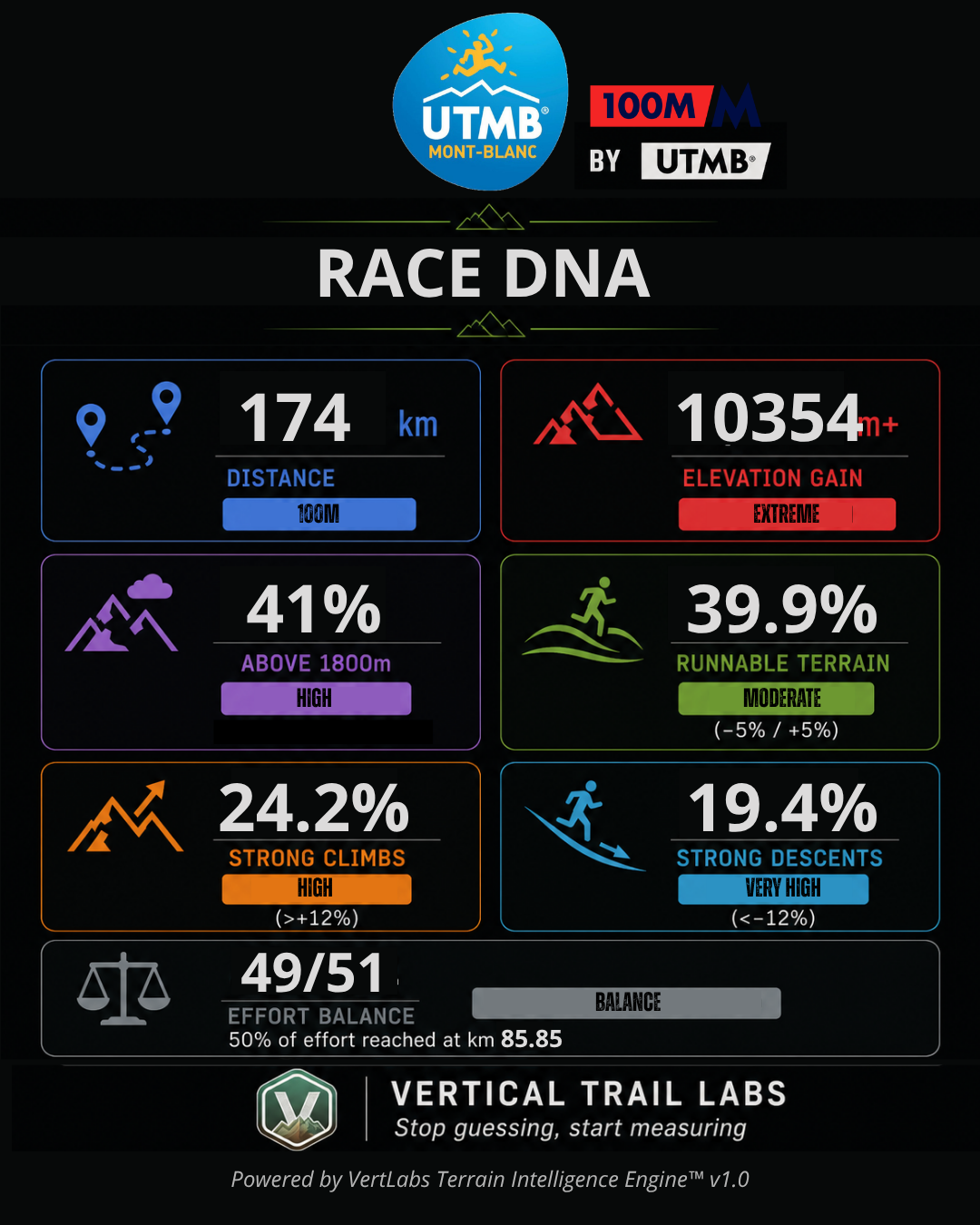
The UTMB 2026 is a 174 km circumnavigation of Mont-Blanc through France, Italy and Switzerland, officially carrying around 9,900 m of elevation gain. The Vertical Trail Labs engine, working from the course GPX, identifies 10,354 m+, giving the race a Vertical Density of approximately 59.5 m+/km. The difference reflects the way the GPX processes the terrain and elevation rather than a different race distance. The race starts in Chamonix at 17:45 on Friday, August 28, sending runners into their first mountain night almost immediately.
The numbers describe a course that is vertically extreme but mechanically more balanced than its reputation might suggest. Around 41% of the course is above 1,800 m, while approximately 39.9% falls within rolling terrain. That means UTMB is not simply a sequence of steep climbs: there is a substantial amount of terrain where efficient running becomes a major performance factor. At the same time, 24.2% of the course is classified as Strong Climb and 19.4% as Strong Descent, creating a large cumulative mechanical load on both the uphill and downhill systems.
he profile reveals several distinct mountain blocks rather than one continuously difficult section. The opening part gradually builds toward the first major high-altitude terrain, before the course enters its first substantial climbing and descending sequence. The middle of the race then becomes increasingly complex, with repeated climbs above 2,000 m separated by long runnable or rolling sections. These transitions are critical: the ability to change efficiently from climbing to descending and then back into sustained running can save more time than simply being fast on any individual ascent.
One of the defining characteristics of this UTMB is the distribution of effort. The engine places the 50% effort point at approximately km 85.9, producing a 49/51 physical-distance split. In other words, half of the total effort has been accumulated by roughly the halfway point of the course. This is remarkably balanced for a race with more than 10,000 m of climbing. There is no obvious "easy half" of the UTMB: the course continues demanding meaningful climbing and descending deep into the second night.
The first major strategic challenge is therefore pacing the early mountains without sacrificing running economy. The spectacular opening sections can encourage aggressive climbing, particularly among athletes racing for position. But the UTMB still has more than 80 km of substantial mountain terrain remaining when the effort balance reaches 50%. Early efficiency matters more than early speed.
The second half is where the course increasingly tests fatigue resistance. The profile continues to produce significant climbs after the halfway point, including several distinct ascents above 1,800–2,000 m. By then, runners are no longer simply managing cardiovascular effort; accumulated eccentric damage from the descents becomes a major limiter. The ability to descend without destroying the legs becomes essential because every major descent is effectively preparation for another climb.
The final section is particularly revealing. After more than 150 km, the profile still contains meaningful elevation changes before the final descent toward Chamonix. There is therefore no point where the race can simply be considered "finished" from a biomechanical perspective. The athlete who reaches the final mountains with functional legs can convert that remaining terrain into running speed; the athlete who has accumulated excessive downhill damage will lose efficiency rapidly.
Altitude adds another layer. With 41% of the course above 1,800 m, exposure is classified as High rather than merely incidental. Several of the major climbs take runners well above 2,000 m, meaning that altitude repeatedly interacts with climbing intensity rather than appearing only at one isolated summit.
And there is one additional factor for this edition: the first night is expected to be cold and wet in the mountains, according to the current race information from UTMB. That makes clothing and temperature management particularly relevant because the race begins in the evening and the athletes will spend the first night moving through the high sections of the course.
Vertical Trail Labs Verdict
UTMB is not a race of one decisive climb. It is a race of accumulated efficiency.
With 10,354 m+, 59.5 m+/km, 41% above 1,800 m, 24.2% Strong Climb, 19.4% Strong Descent and a virtually perfect 49/51 effort balance, the course continuously asks the same question:
How much performance can you preserve for the next mountain?
The strongest strategy is therefore not to maximize speed on any single section, but to minimize the efficiency lost between them — climb economically, descend under control, run whenever the terrain allows it, and arrive at the final mountains with enough mechanical capacity to still move efficiently.
The UTMB Race DNA: extreme vertical load, high-altitude exposure, substantial runnable terrain, and almost perfectly balanced effort from start to finish.
And tomorrow, the mountain gets the final word.