
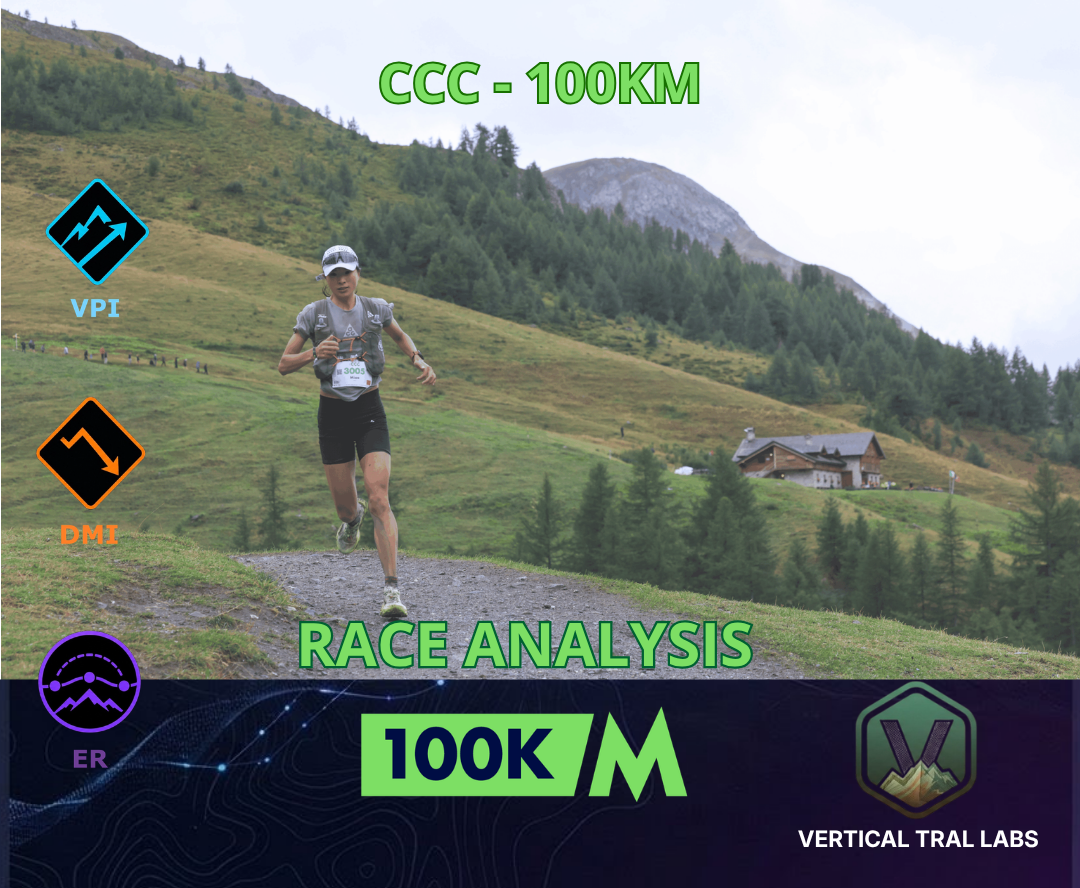
CCC 100K: The Numbers Behind Minoggio’s Control and Kaspersen’s Comeback
Race Overview
The 2026 CCC was far from a standard edition.
Originally designed around the traditional 100K format, the course was modified because of severe weather. The final course measured approximately 107.8 km with 6,200 m of elevation gain, with the final La Flégère section removed. Rain and muddy terrain made the race particularly demanding.
The race also had unusually high stakes. The CCC served as the UTMB World Series 100K Final, with the top three men and women earning Western States 2027 Golden Tickets.
The men's race eventually became a battle between three very different profiles. Hans Troyer was aggressive early, Miguel Arsénio progressively moved forward, while Minoggio remained in control and opened the decisive gap during the second half. By Vallorcine, around km 90, Minoggio had more than seven minutes over the chasing group.
The women's race was almost the opposite. Toni McCann and Miao Yao controlled much of the early race, while Kaspersen came from well behind. At the finish, the Norwegian had turned that deficit into a five-minute victory.
One additional complication should be kept in mind when interpreting the men's final times: several runners received official time credits because of the train/level-crossing interruption. Luke Grenfell-Shaw received 14 minutes, Simon Paccard 12, Daniel Jones 10, and Ji Duo, Guillaume Tiphène and Mathieu Delpeuch six minutes each.
Men’s Race Analysis
Top 10
| Pos | Dorsal | Corredor | Tiempo | VPI | DMI | ER | Ritmo 1ª Mitad | Ritmo 2ª Mitad |
|---|---|---|---|---|---|---|---|---|
| 1 | 3002 | Cristian MINOGGIO | 10:21:48 | 1274.5 | 15.65 | 88.6 | 3.39 min/km | 3.77 min/km |
| 2 | 3037 | Miguel ARSENIO | 10:27:25 | 1265.1 | 15.54 | 87.0 | 3.39 min/km | 3.83 min/km |
| 3 | 3031 | Hans TROYER | 10:33:29 | 1253.4 | 15.26 | 84.9 | 3.38 min/km | 3.89 min/km |
| 4 | 3051 | Luke GRENFELL-SHAW | 10:47:23 | 1218.1 | 14.55 | 78.0 | 3.4 min/km | 4.15 min/km |
| 5 | 3047 | Simon PACCARD | 10:50:59 | 1212.5 | 14.53 | 78.9 | 3.42 min/km | 4.15 min/km |
| 6 | 3006 | Daniel JONES | 10:54:14 | 1208.6 | 14.49 | 85.4 | 3.55 min/km | 4.07 min/km |
| 7 | 3027 | Ji DUO | 10:58:26 | 1204.5 | 14.58 | 77.6 | 3.41 min/km | 4.17 min/km |
| 8 | 3073 | Guillaume TIPHENE | 10:58:26 | 1219.2 | 14.3 | 83.8 | 3.52 min/km | 4.09 min/km |
| 9 | 3115 | Mathieu DELPEUCH | 10:59:16 | 1210.4 | 14.32 | 87.9 | 3.61 min/km | 4.05 min/km |
| 10 | 3059 | Anthony FELBER | 11:06:39 | 1199.8 | 14.48 | 83.4 | 3.53 min/km | 4.11 min/km |
The first thing the Vertical Trail Labs data reveals is just how tightly packed the strongest performances were.
All three podium finishers exceeded 1250 VPI and 15.2 DMI, creating a clear separation from the rest of the field.
But the numbers also explain why Minoggio was able to convert that physical advantage into a win.
Position Progression
Cristian MINOGGIO (Bib 3002) produced the most complete performance of the men's race.
His VPI of 1274.5 was the highest of the Top 10, as was his DMI of 15.65. That combination is particularly important on a course such as the CCC, where performance is repeatedly determined by the ability to climb efficiently and then preserve speed on technical descents.
The race report confirms that Minoggio's decisive move came during the climb toward Trient. He then extended the advantage through the final section, arriving at Vallorcine more than seven minutes clear. The VTL numbers show that this was not simply an aggressive move followed by survival.
Minoggio's pace changed from 3.39 to 3.77 min/effort-km, a deterioration of only 0.38. Among the men's Top 10, that was the smallest slowdown. In other words, the winner combined the highest vertical power, the highest descending performance, and one of the best levels of performance retention.
That is a very strong winning profile.
Miguel Arsénio: the strongest challenger
Miguel ARSÉNIO (Bib 3037) finished only 5:37 behind Minoggio and produced almost identical first-half efficiency: 3.39 min/effort-km. His VPI of 1265.1 and DMI of 15.54 were both second among the Top 10.
But there is an interesting difference. His ER was 87.0, compared with Minoggio's 88.6, and his pace deterioration was slightly larger: 3.39 → 3.83, a 0.44 slowdown. That difference may look small, but at this level it becomes meaningful over the final 50 kilometres.
Arsénio's second half was nevertheless excellent. He progressively moved through the field and eventually separated from Troyer for second place.
Hans Troyer: huge early power, slightly less retention
Hans TROYER (Bib 3031) actually recorded the fastest first-half pace of the men's Top 10: 3.38 min/effort-km. His VPI of 1253.4 and DMI of 15.26 also placed him third in both categories. This fits the race narrative perfectly. Troyer was one of the aggressive front-runners and was involved in the lead group through the early and middle sections. He eventually could not respond when Minoggio increased the pressure toward Trient.
His pace moved from 3.38 → 3.89, a 0.51 deterioration. That is still an outstanding performance, but it shows the difference between producing exceptional early speed and maintaining it deep into the race.
The hidden performance: Mathieu Delpeuch
One of the most interesting numbers belongs to Mathieu DELPEUCH.
He finished ninth in 10:59:16, but his ER of 87.9 was the second-highest among the men's Top 10, behind only Minoggio's 88.6. His pace also deteriorated by only 0.44, from 3.61 → 4.05. That is remarkably close to Arsénio's retention despite a lower VPI. His final position therefore understates the quality of his performance.
The official results confirm Delpeuch's ninth place, while the VTL data suggests that his race was considerably more efficient than the final ranking alone would imply.
Daniel Jones: efficiency beyond the raw VPI
Daniel JONES (Bib 3006) is another interesting case.
His VPI was only 1208.6, well below the podium, but his ER reached 85.4. His second-half deterioration was also only 0.52. That helped him finish sixth despite starting from a less dominant vertical profile.
Meanwhile, Luke GRENFELL-SHAW (Bib 3051) produced an impressive fourth-place result, but his 0.75 pace deterioration was one of the largest in the Top 10. His result was helped by an excellent race overall and a strong progression through the field, but the VTL data suggests that he had to spend considerably more of his performance budget to produce that result.
VPI Analysis — Men
The men's VPI hierarchy is extremely clear:
Minoggio → Arsénio → Troyer
And that hierarchy mirrors the podium.
But the deeper story is that VPI alone does not explain the entire Top 10.
Mathieu Delpeuch, for example, ranked ninth in VPI but second in ER among the men's Top 10. Daniel Jones also converted a relatively modest VPI into a sixth-place finish through stronger endurance characteristics.
That is exactly where the Vertical Trail Labs framework becomes useful:
Vertical power explains who can attack. ER helps explain who can keep attacking.
Women’s Race Analysis
Top 10
| Pos | Dorsal | Corredor | Tiempo | VPI | DMI | ER | Ritmo 1ª Mitad | Ritmo 2ª Mitad |
|---|---|---|---|---|---|---|---|---|
| 1 | 3007 | Yngvild KASPERSEN | 12:01:14 | 1125.0 | 13.09 | 97.7 | 4.14 min/km | 4.23 min/km |
| 2 | 3015 | Toni MCCANN | 12:06:14 | 1104.2 | 13.18 | 85.3 | 3.88 min/km | 4.45 min/km |
| 3 | 3005 | Miao YAO | 12:15:41 | 1100.0 | 12.93 | 83.1 | 3.89 min/km | 4.54 min/km |
| 4 | 3003 | Jennifer LICHTER | 12:24:01 | 1084.6 | 12.94 | 84.6 | 3.96 min/km | 4.57 min/km |
| 5 | 3011 | Caitlin FIELDER | 12:25:17 | 1081.2 | 12.89 | 92.4 | 4.15 min/km | 4.46 min/km |
| 6 | 3028 | Anna-Stiina ERKKILÄ | 12:36:12 | 1060.8 | 12.78 | 85.0 | 4.04 min/km | 4.64 min/km |
| 7 | 3019 | Honoka AKIYAMA | 12:37:02 | 1074.0 | 12.52 | 81.7 | 3.97 min/km | 4.7 min/km |
| 8 | 3048 | Adeline MARTIN | 12:45:38 | 1057.8 | 12.37 | 84.3 | 4.07 min/km | 4.71 min/km |
| 9 | 3042 | Marie GONCALVES | 12:51:08 | 1038.2 | 12.49 | 88.0 | 4.19 min/km | 4.69 min/km |
| 10 | 3032 | Theres LEBOEUF | 12:58:47 | 1030.6 | 12.43 | 80.8 | 4.06 min/km | 4.84 min/km |
The women's numbers are extraordinary. The most important metric is not VPI.
It is ER and one athlete sits clearly above the rest.
Position Progression
Yngvild KASPERSEN (Bib 3007) produced perhaps the most striking performance of the entire CCC.
Her VPI of 1125.0 was the highest in the women's Top 10, while her DMI of 13.09 placed her near the top. But the real number is her ER: 97.7. That is dramatically higher than the rest of the women's Top 10.
And then comes the most remarkable figure: 4.14 → 4.23 min/effort-km. Only 0.09 of deterioration.
For comparison, every other woman in the Top 10 slowed by at least 0.31. This explains the comeback better than the final ranking does. Kaspersen did not simply run faster late. She almost refused to slow down.
According to race tracking, she was outside the women's Top 10 around halfway and roughly 20 minutes behind the leader. She then moved progressively through the field: 92nd overall at Champex-Lac, 60th at Trient, 49th at Vallorcine and 29th overall at the finish.
Her victory was therefore not a traditional front-running performance. It was an endurance collapse of everyone around her combined with extraordinary retention of her own performance.
Toni McCann vs Miao Yao
Toni MCCANN (Bib 3015) and Miao YAO (Bib 3005) tell another fascinating story.
Their first-half numbers were almost identical: McCann: 3.88 Yao: 3.89
But their second halves diverged: McCann: 4.45 Yao: 4.54
That difference of only 0.09 min/effort-km was enough to become significant over the closing stages. McCann's ER was also slightly higher: 85.3 vs 83.1.
The race narrative matches the numbers. McCann and Yao spent much of the race battling at the front, but Kaspersen was progressively closing the gap. McCann eventually passed Yao before Kaspersen overtook both in the final part of the race. The numbers suggest that McCann retained slightly more of her performance, which ultimately allowed her to defend second place.
Caitlin Fielder: the hidden performance
One of our favorite numbers in this women's field is Caitlin FIELDER (Bib 3011). She finished fifth, but her ER of 92.4 was the second-highest women's value. And her pace deterioration was just 0.31, the second-smallest in the Top 10 after Kaspersen.
Her VPI was only 1081.2, which ranked fifth. So once again, final ranking and raw vertical power don't tell the entire story.
Fielder's numbers describe an athlete who maintained her performance exceptionally well as the race progressed. That becomes particularly important in a race where rain, mud and course modifications increased the endurance component of the challenge.
Jennifer Lichter
Jennifer LICHTER (Bib 3003) had a very balanced performance:
VPI: 1084.6 DMI: 12.94 ER: 84.6 Pace: 3.96 → 4.57
She finished fourth, only 1:17 before Fielder.
Her numbers place her between the high-power front runners and the strongest endurance profiles. That makes fourth place consistent with the overall shape of her performance.
VTL Insights
The CCC 2026 gives us one of the clearest demonstrations yet of why Vertical Trail Labs looks beyond final ranking.
1. Minoggio's victory was a complete vertical performance
He was first in VPI and first in DMI. He was first in ER among the men's Top 10.
And he had the smallest pace deterioration, there is very little ambiguity in the numbers.
He had the strongest combination of power, technical ability and retention.
2. Kaspersen's victory was fundamentally different
She did not win because she had the fastest opening half. She won because her performance barely deteriorated. Her 0.09 slowdown is extraordinary.
That is the defining number of the entire women's race.
3. The podium was not simply a ranking of VPI
On the men's side, the podium perfectly followed VPI. On the women's side, however, Toni McCann had the highest DMI, while Kaspersen had the highest VPI and overwhelmingly highest ER.
This suggests that the women's race was more strongly shaped by performance retention than by a single dominant physical characteristic.
4. ER reveals athletes hidden by the final classification
Mathieu Delpeuch — ER 87.9, 9th. Caitlin Fielder — ER 92.4, 5th.
Both performances look substantially more interesting when viewed through endurance efficiency.
And then there is Kaspersen: ER 97.7 — 1st.
The metric almost reads like a fingerprint of the race.